
Automating Daily Market Intelligence Briefs for Financial Consulting Firm
Custom newsletter automation
Brian Faust runs Contrail Financial, a financial and strategic consulting firm serving clients across multiple industries. As a solo consultant, Brian's most valuable asset is his time - every hour spent on manual administrative work is an hour not spent advising clients or developing new business.
Brian maintained close relationships with approximately 10 clients (with plans to scale to 50-100) by sending personalized daily news briefs covering relevant market developments, industry trends, and regulatory changes. Each client operated in different sectors - from ad tech and automotive to venture capital and energy - requiring highly customized content.
The manual process consumed significant founder time: reviewing hundreds of RSS articles daily, identifying relevant items for each client, writing contextualized summaries, and assembling individual emails. This wasn't scalable, and as a non-technical founder, Brian needed a reliable automation partner who could translate his vision into a production-grade system without requiring him to become a developer.
Brian faced several interconnected problems:
Time Drain on Founder Capacity
Manually curating and writing daily briefs for 10 clients took hours each day - time that should have been spent on high-value consulting work. Scaling to 50-100 clients would be impossible without automation.
Inconsistent Personalization at Scale
Each client needed content filtered through their specific lens: different industries, competitors, risk topics, and strategic priorities. Generic news aggregation wouldn't work. The value was in the "So What?" - why each article mattered specifically for that client's business.
Cost Predictability Concerns
As a financial consultant, Brian was particularly sensitive to unpredictable operating costs. He needed transparent, controllable expenses as the system scaled.
No Technical Background
Brian described himself as "not a technical person at all" - he needed a solution he could manage independently through simple interfaces, without touching code or complex configurations.
Reliability Requirements
These briefs served both as client service and marketing tool for prospects. The system needed to work consistently every morning without manual intervention or surprises.
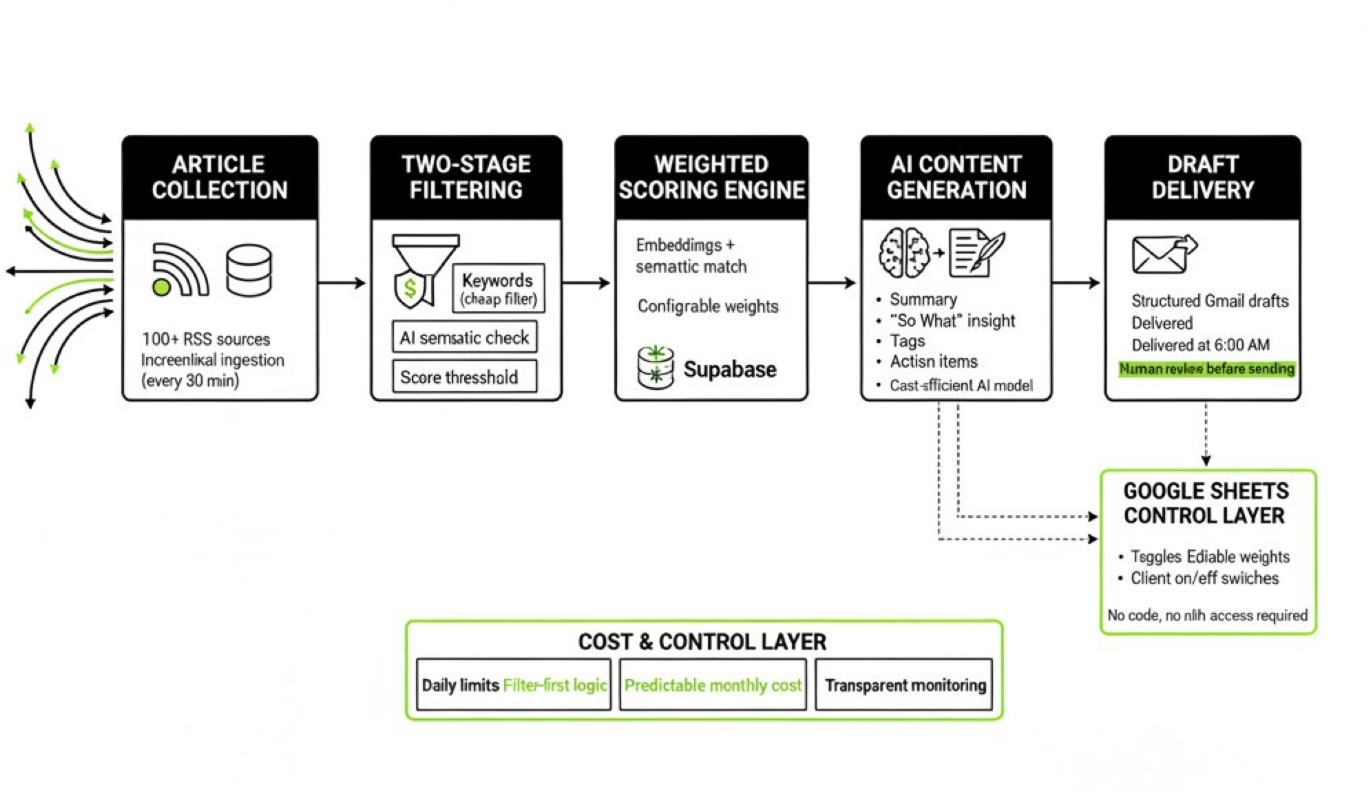
We built a five-module automation infrastructure using n8n, treating it as production-grade engineering rather than a quick automation hack.
Module 1: Article Collection
Implemented automated collection from 100+ RSS feeds via Inoreader API every 30 minutes. Rather than overwhelming the system with all articles at once, we designed an incremental collection to maintain consistent performance.
Module 2: Intelligent Filtering
Created a two-stage filtering process to control AI costs:
This approach meant we weren't sending every article through expensive GPT analysis - we filtered first, then applied intelligence.
Module 3: Vectorized Scoring System
Built a weighted scoring mechanism based on Brian's methodology document. The system:
Brian later requested the ability to adjust weights dynamically - we moved all weight configurations into a Google Sheets "Variables" tab he could edit himself without touching n8n.
Module 4: Personalized Content Generation
For articles passing the relevance threshold, GPT generated:
We chose GPT-4o-mini for cost efficiency while maintaining quality, with the flexibility to upgrade models if needed.
Module 5: Draft Assembly and Delivery Created structured Gmail drafts containing:
Critically, drafts appeared at 6:00 AM EST in Brian's inbox-not auto-sent-giving him review control before distribution.
Cost Control Infrastructure Built-in guardrails included:
At 10 clients processing ~6,000 articles monthly, operating costs ran $55-60/month. Even scaling to 50 clients would only increase costs to $180-200/month which is highly predictable and controlled.
Non-Technical Interface
Everything Brian needed to manage lived in Google Sheets:
No code required. No n8n access needed for daily operations.
Discovery and Requirements Refinement (Week 1)
Rather than overwhelming Brian with technical details, we focused on outcomes and business logic. When he shared his scoring methodology document, we translated his business thinking into technical architecture.
Technical Challenges Encountered
Feedly API access proved limited - their developer token required Enterprise accounts. Rather than treating this as a blocker, we researched alternatives and migrated to Inoreader, which offered better API access at lower cost.
Development Approach (Weeks 2-3)
We built iteratively:
Documentation and Handoff
Created operational documentation covering:
We formatted documentation for a non-technical audience - no jargon, just clear operational procedures.
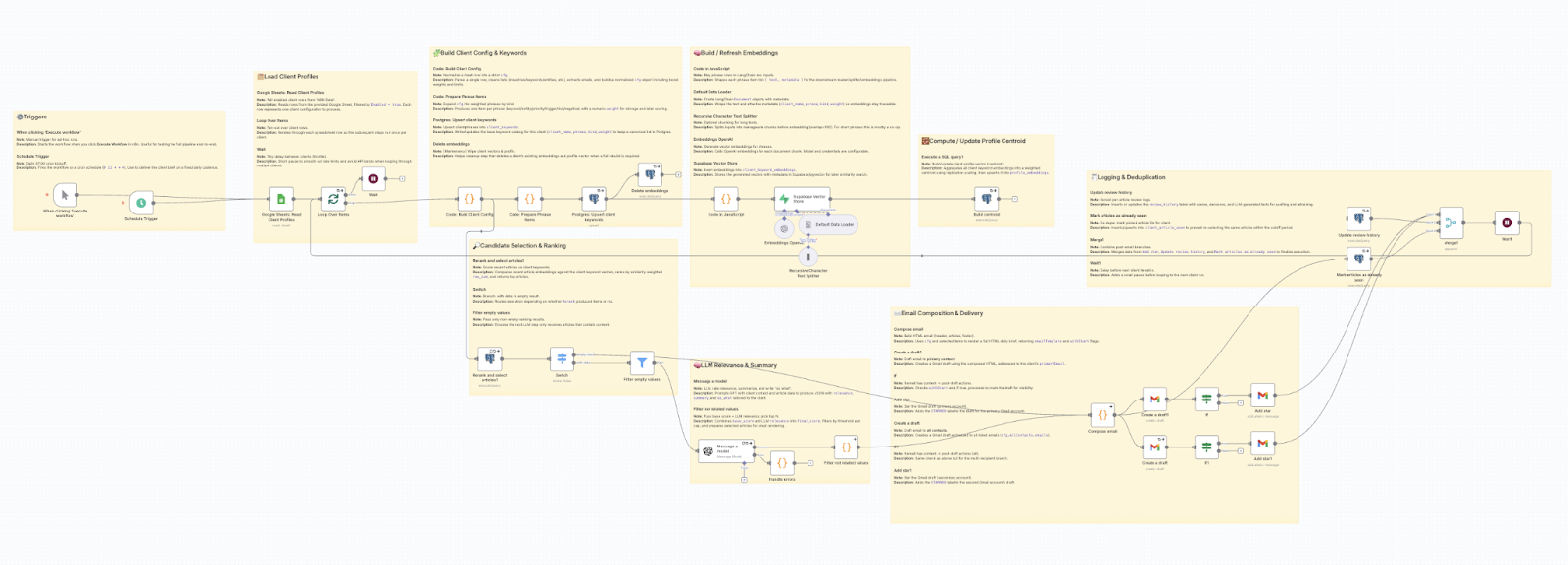
Embedded documentation - the workflow is self-documented - you look at it and immediately understand what happens inside.
Brian went from spending hours daily on manual curation to spending 10-15 minutes reviewing pre-drafted briefs each morning. Conservatively estimating 2 hours saved per day at 5 days per week:
For a solo consultant billing $150-300/hour, that's $54,000 - $108,000 in recovered capacity annually.
Scalability Unlocked
The system can now handle 50-100 clients without proportionally increasing Brian's time investment. The hard work - collection, filtering, analysis, and drafting - happens automatically. His role became editorial review rather than content creation.
Consistent Quality
Every client receives a personalized brief every morning, without variation based on Brian's workload or schedule. The consistency strengthened his positioning as a reliable strategic partner.
Marketing Tool Activation
With automation handling existing clients, Brian could extend briefs to prospects as a lead nurturing mechanism - demonstrating value before any commitment. Previously, this would have been impossible given time constraints.
Predictable, Controlled Costs
Operating expenses at 10 clients: $55-60/month Projected at 50 clients: $180-200/month Even at scale, the system costs less than one billable hour per month while saving dozens of hours monthly.
Founder Focus Restored
Most importantly, Brian reclaimed founder capacity for high-value work: strategic consulting, business development, and relationship management. The automation didn't replace his expertise - it freed him to apply that expertise where it mattered most.
Stack
Architecture Highlights
Scalability Design
The system was architected for 10x growth from day one. Database schema, API rate limiting, and workflow structure all accommodate 100+ clients without redesign. Costs scale linearly and predictably with client count.
This project exemplifies the real opportunity in SMB automation: saving founder time at businesses that can't justify full-time engineering teams.
Brian's firm operates lean. He can't hire a development team. He can't spend months learning to code. He needs systems that work reliably, cost predictably, and don't require technical expertise to maintain.
That's the market position 2V Automation occupies - we're not building quick Zapier flows or charging Big 4 consulting rates. We're engineering production-grade infrastructure for serious businesses that need reliability without requiring technical founders.
The alternative for Brian wasn't hiring another automation freelancer. It was either continuing to do it manually (unsustainable) or hiring a full-time assistant (expensive, still manual). Automation infrastructure created a third path: reliable systems that scale with the business.
By focusing on engineering fundamentals - cost control, error handling, scalability, and non-technical usability - we delivered a system that didn't just work once, but works every day.
Brian recovered hundreds of hours annually, unlocked scalability to 10x his client base, and paid less per month than a single billable hour.
More importantly, we proved that small consulting firms don't have to choose between founder time and client service quality. The right automation infrastructure delivers both.
I had a great experience working with 2V Automation. They were highly responsive, knowledgeable, and professional throughout the project. The team delivered the full scope quickly and efficiently, meeting my expectations in both quality and communication. I'd confidently recommend 2V Automation to anyone looking for a capable and dependable automation partner.