How Fire Plan Strategies Eliminated 230 Hours of Manual Work Monthly Without Hiring
Full automation backbone
Project timeline:
12 weeks from discovery to production deployment
Industry:
Facility Services - Fire Safety Compliance
What was automated
Lead intake
Proposal and pricing quote preparation
Client onboarding
Project Invoicing
Reporting Dashboards
The Situation (Before We Showed Up)
Fire Plan Strategies, a Canada-wide fire safety services company, was drowning in manual operations. Their two service lines, fire safety plan development and fire safety training, shared the same fundamental problem: every lead required extensive manual data entry across multiple systems.
What was breaking:
Invoice processing averaged 14 days from work completion to payment. Not because clients were slow, but because their bookkeeper batched invoices weekly
~230 hours per month consumed by manual data shuffling: copying client details from inquiry forms into Podio, recreating the same information in pricing agreements, manually entering line items into QuickBooks, processing training certificates one by one
Zero visibility into real-time cash flow, the CEO would wake up to discover $5,000 in "surprise" invoices that had been sitting in the backlog
Proposal generation required manually copying data from Podio into JotForm templates, creating opportunities for errors and inconsistency
Why Previous Attempts Failed
Fire Plan had tried to solve this three times before:
Native integrations between their tools These worked until they didn't. When integrations broke, they had no way to fix them or even understand what went wrong. They were entirely dependent on the platform vendors to resolve issues.
Zapier automation A staff member who "knew how to handle the remote control" built various Zaps over time. The result: a sprawling mess where nobody knew which automations actually worked, which were outdated, and which were silently failing. Parts of the system hadn't been touched in months, and there was no documentation.
DIY internal attempts Their technically-inclined staff member got Power BI dashboards partially working but couldn't complete the critical automation between JotForm pricing agreements, Podio project tracking, and QuickBooks invoicing.
The pattern was clear: they needed production-grade systems, not duct-tape solutions that would break the moment someone left or a platform updated.
What We Actually Built
We migrated their entire automation infrastructure to n8n - a self-hosted workflow automation platform that gave them complete control and transparency. As a certified expert n8n partner, we know exactly how to do it the right way.
Unlike their previous Zapier setup or unreliable native integrations, every workflow was now documented, version-controlled, and maintainable.
The automation backbone:
Lead-to-Invoice Flow:
Website inquiry forms automatically create Podio opportunities with all client details structured correctly
AI-powered pricing agreement generation pulls data from Podio, populates JotForm templates with proper line items and tax calculations, and emails agreements to clients-no more copying from comments
Signed agreements trigger automatic project creation (FSP or Training type based on service selection)
Customer records are created/matched in QuickBooks using a standardized naming convention (FirstName LastName-OpportunityID) to prevent duplicates
Smart Invoicing System:
FSP projects: Phase 1 completion triggers first invoice (90% of total), project shipment triggers second invoice
Training projects: Completion triggers single invoice
Province-based tax calculation using conversion table in Google Sheets (GST, HST, PST/QST) eliminating manual tax code selection
All invoices automatically include correct project IDs for dashboard tracking
Certificate Automation:
Payment receipt in QuickBooks triggers certificate generation workflow
System reads attendee list from Google Sheets (names, emails, company)
Matches training type to appropriate Certifier template
Generates and emails individual certificates to all participants-no more manual entry into Certifier
Key architectural decisions:
Self-hosted n8n on dedicated server instead of cloud pricing-eliminated per-execution costs that would have been significant at their volume
Google Sheets as lightweight database for tax mapping and training type configurations-easy for non-technical staff to update without developer involvement
Comprehensive error reporting to dedicated email (automations@fireplan.ca) with workflow name, failure point, timestamp, and relevant IDs
Daily sync of QuickBooks products and tax codes to Podio maintaining data consistency
Migration from chaos: We didn't just build new automations. We audited their existing Zapier workflows, identified which were actually in use versus abandoned, and rebuilt everything in n8n with proper documentation. Every workflow now has clear triggers, expected execution times, and error handling.
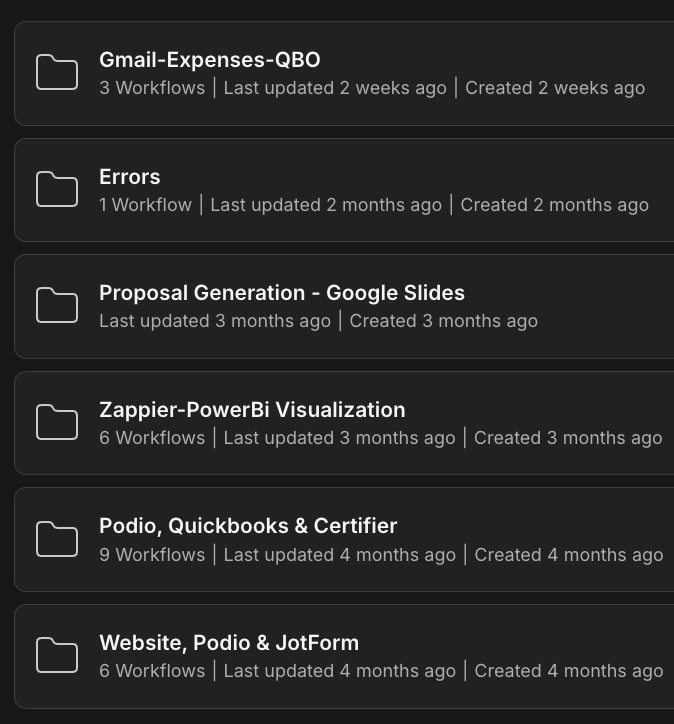
Workflows organized by functional area
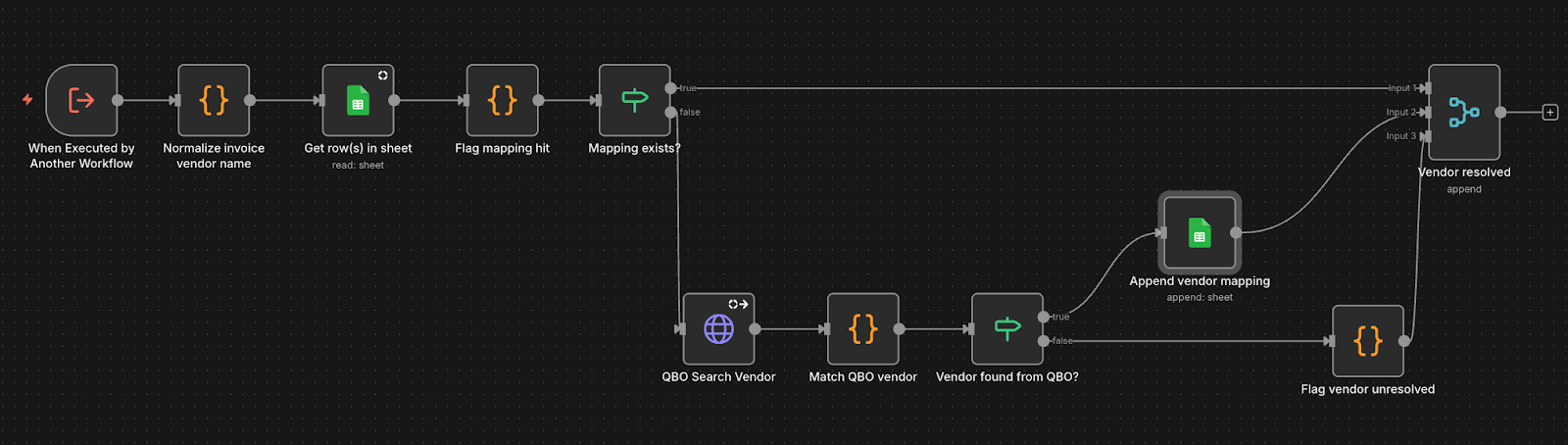
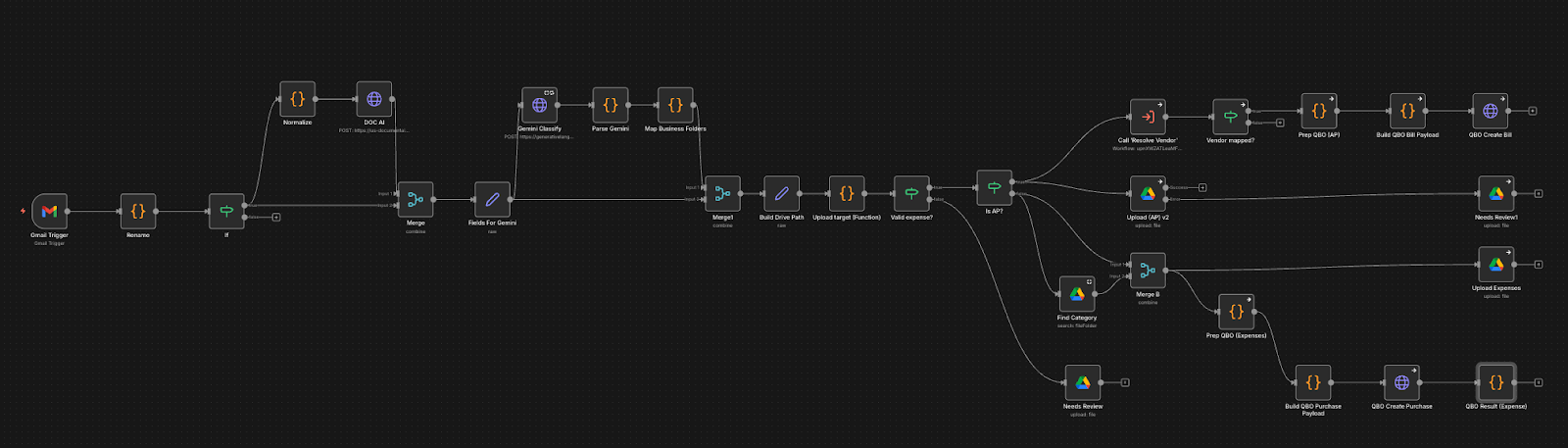
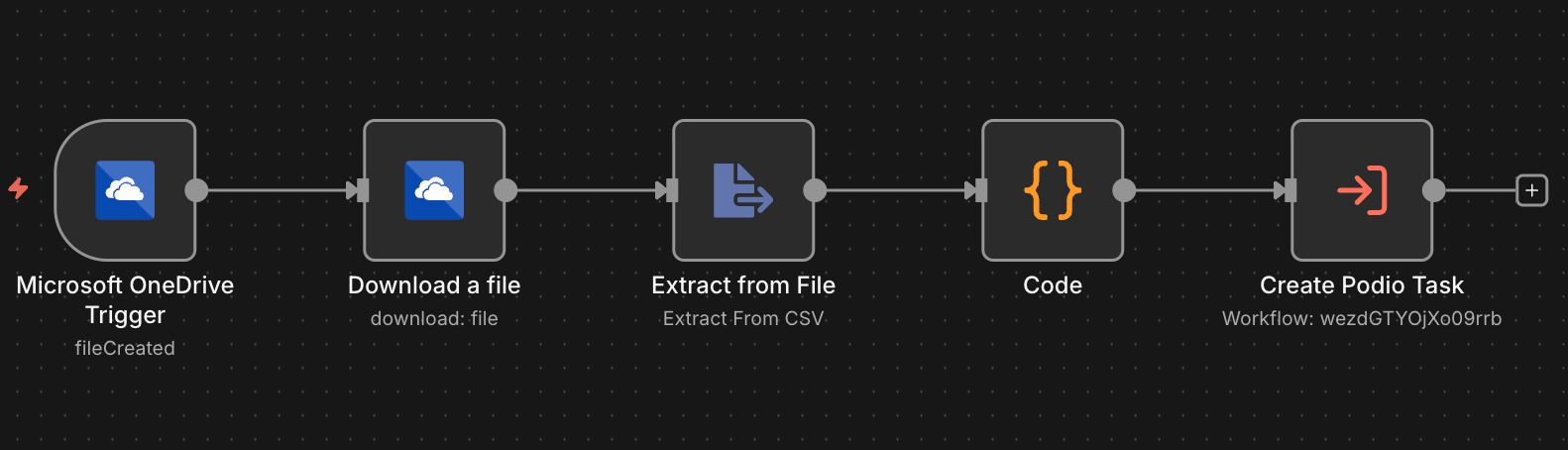
Example workflows
We avoid monstrous non-readable workflows and prefer structured, modular approach. We break down complex logical structures into smaller workflows and sub-workflows in n8n that are easy to understand and maintain.
The Numbers
Manual operations time eliminated: ~230 hours/month broken down as:
Lead intake and data entry: ~40 hours
Proposal and pricing agreement preparation: ~60 hours
Client onboarding data transfer: ~30 hours
Invoice creation and processing: ~80 hours
Certificate generation and distribution: ~20 hours
Time-to-payment: 14 days → 2 days
Previous: Bookkeeper batched invoices weekly, creating 7-14 day delays before clients even received bills
Current: Invoices generated within 20 seconds of milestone completion, immediately sent to clients
Cost savings breakdown:
Eliminated part-time bookkeeper position for invoice processing: $2,400/month
Reduced operations staff time on manual tasks: $3,800/month equivalent (230 hours × $16.50/hr average)
Total monthly savings: $6,200 ($74,400 annually)
The Handoff Process
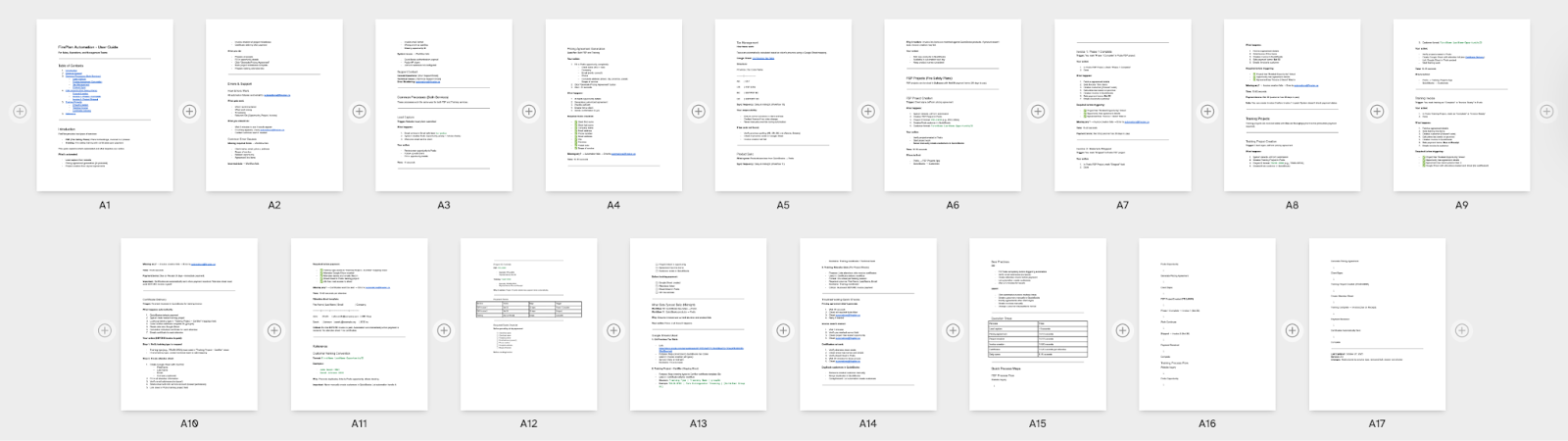
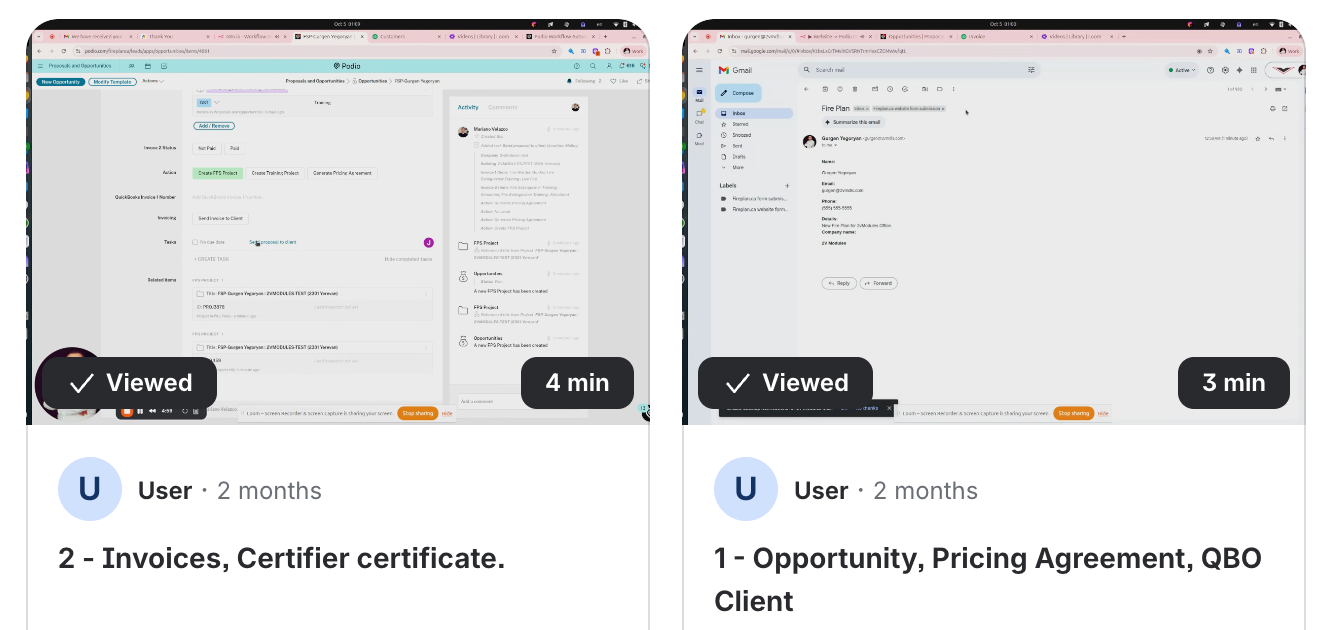
We’ve prepared detailed documentation and video tutorials for the team.
All the docs we prepare are kept up-to-date with our retainer service so that the “nobody-knows-how-this-zapier-works” situation will never happen again.
Project documentation and videos
What's Still Running
The system processes 100+ fire safety plan inquiries with 99%+ uptime. Every workflow execution is logged, and failures trigger immediate notifications rather than silently breaking like their previous integrations.
The CEO now has real-time visibility into cash flow instead of weekly surprise batches. Project managers can focus on client work instead of data entry. And the company has complete control over their automation infrastructure-when something needs to change, they can update a Google Sheet themselves or request specific workflow modifications without being hostage to third-party platform limitations.
The Next Steps
We continue to work with Fire Plan Strategies and automate other areas of their business making them more efficient, eliminating manual hours, reducing errors, building tools that unlock new opportunities.
Key results
Manual ops time eliminated
~230hrs/month
Time-to-payment
14 days → 2 days
★★★★★
This is music to my ears. Our accountant is definitely going to love this because she's not going to have to do invoices anymore. The admin staff is also going to love it because they're not going to have to manually do each one of those certificates.


.png)