DevOps Automation Services
DevOps Automation That Delivers ROI in 6 Months
Results our $1M+ clients see
The DevOps Automation Problem
Deployment delays hurt velocity
Manual deployment steps create bottlenecks. Code sits waiting for approval, testing, or environment setup. Teams that should ship multiple times daily are lucky to deploy weekly.
Infrastructure management consumes engineering time
Your engineers provision servers, configure environments, and manage cloud resources manually. Time that should go toward building features goes toward keeping systems running.
Incidents take too long to detect and resolve
Problems reach production before monitoring catches them. When alerts fire, teams scramble to understand what broke and where. Mean time to recovery stretches into hours.
Tool sprawl creates gaps
Your CI/CD, monitoring, infrastructure, and security tools don't communicate. Data lives in silos. Teams cobble together scripts and workarounds that break when anything changes.
Security and compliance checks slow everything down
Manual security reviews create deployment gates. Compliance requirements mean documentation and audit trails get skipped under pressure.
What We Implement
We install complete DevOps automation systems that eliminate manual work and deliver consistent, reliable infrastructure operations.
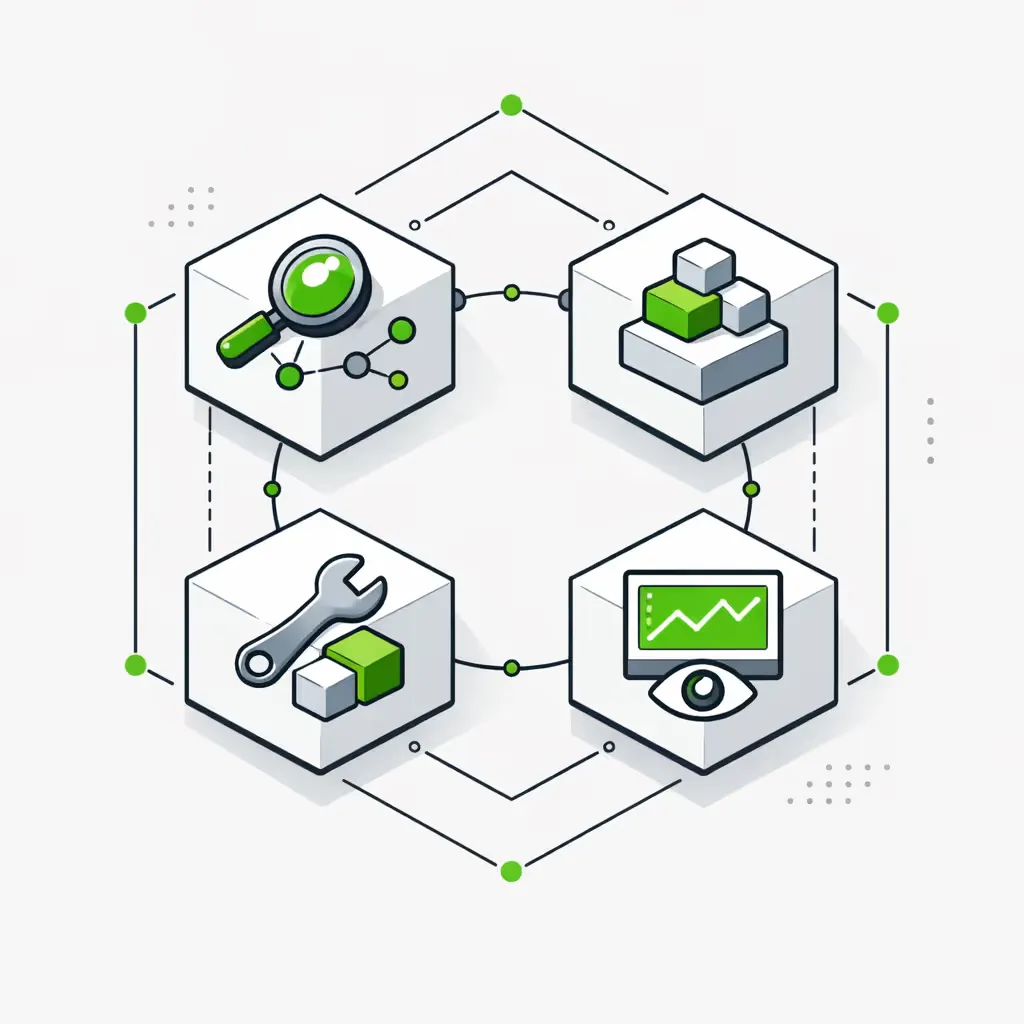
The DevOps Automation Backbone
We install the complete DevOps automation infrastructure your business needs:
CI/CD Pipeline Automation
Automated integration, testing, and deployment pipelines that move code from commit to production without manual intervention. Every code change triggers builds, runs tests, scans for vulnerabilities, and deploys to the right environment. Failed builds stop bad code before it reaches production.
Infrastructure as Code (IaC)
Your entire infrastructure defined as code and version-controlled. Servers, networks, databases, and cloud resources provision consistently across environments. Changes review like code. Rollbacks happen instantly. New environments spin up in minutes, not days.
Container Orchestration and Configuration Management
Kubernetes, ECS, or Cloud Run configurations that handle scaling, load balancing, health checks, and recovery automatically. Consistent configuration across all servers and environments. Configuration drift gets detected and corrected. Server configurations match exactly.
Automated Testing and Quality Gates
Comprehensive test automation that validates code quality, security, performance, and functionality before deployment. Unit tests, integration tests, security scans, and performance checks run on every change. Quality gates block flawed code automatically — manual testing drops by 80%.
Monitoring, Observability, and DevSecOps
Real-time visibility into application performance, infrastructure health, and system behavior. Automated vulnerability scanning, dependency checks, secrets management, and compliance validation integrated into every pipeline stage. Problems detected in minutes, not hours. Vulnerabilities caught early. Audit trails generate without manual work.
Custom Builds
When your DevOps stack needs something off-the-shelf can't deliver, we build it. Custom CI/CD steps, bespoke deployment automation, internal developer tooling, integrations with proprietary systems. Runs parallel to backbone installation without slowing it down.
Ongoing Optimization
Continuous monitoring and improvement after launch. We track performance against targets, implement refinements, and ensure systems evolve with your needs. SLA-based response for incidents. Systems stay optimized. Performance improves monthly. Issues resolve before they impact users.
What Makes 2V Different
-
WE IMPLEMENT COMPLETE SYSTEMS, NOT ONE-OFF AUTOMATIONS
Each system designed to work together as an integrated operations backbone. Everything connects. Nothing exists in isolation. -
PRODUCTION-GRADE INFRASTRUCTURE FROM DAY ONE
We build for reliability, security, and scale. Error handling, logging, monitoring, and recovery built into every automation. Systems that work under load and handle failures gracefully. -
MEASURED ROI IN 6 MONTHS
Every system delivers time savings or cost reduction. We track metrics before and after implementation. You see exactly what changed and how much value delivered. -
15 YEARS IMPLEMENTING BUSINESS AUTOMATION
We've built DevOps automation systems across industries. We know what works, what breaks, and what scales. -
YOUR TEAM OWNS EVERYTHING WE BUILD
Complete documentation. Training until your team operates independently. No lock-in. No ongoing vendor dependency.
Core DevOps Automation Capabilities
-

CI/CD Pipeline Automation
Automated integration, testing, and deployment pipelines that move code from commit to production without manual intervention. Every code change triggers builds, runs tests, scans for vulnerabilities, and deploys to the right environment based on your workflow. Your team commits code. The system handles everything else.
-

Infrastructure as Code & Container Orchestration
Your entire infrastructure defined as code and version-controlled. Manual infrastructure changes stop. Configuration drift disappears. Every environment matches production exactly. Kubernetes, ECS, or Cloud Run configurations handle scaling, load balancing, health checks, and recovery automatically. Resources scale based on actual demand, not guesses.
-

Monitoring, Alerting, and Observability
Real-time visibility into application performance, infrastructure health, and system behavior. Automated alerts notify teams of issues before users notice. Dashboards show what matters: error rates, response times, resource utilization, and business metrics. Problems detected in minutes, not hours. Alert noise drops through intelligent routing.
-

Security Automation (DevSecOps)
Security scans integrated into every stage of your pipeline. Automated vulnerability scanning, dependency checks, secrets management, and compliance validation. Security becomes continuous, not a deployment gate. Vulnerabilities caught early. Compliance maintained automatically. Audit trails generate without manual work. Failed security checks block deployment automatically.
DevOps Engagement Models
Full DevOps Automation Implementation
Complete transformation from assessment through deployment and optimization. We handle everything: discovery, strategy, implementation, testing, training, and handoff. Timeline: 4–8 months. Includes all core systems, complete documentation, team training, production deployment.
DevOps Consulting: Strategic guidance without hands-on implementation. We audit your current setup, design automation roadmap, recommend tools, and provide ongoing advisory.
Dedicated Team Augmentation & DevOps-as-a-Service
Our engineers join your team long-term to build and maintain automation systems alongside internal staff. Continuous development, incident response, and knowledge transfer. Timeline: 6–24+ months.
DevOps-as-a-Service: We manage your entire DevOps infrastructure and operations on an ongoing basis. 24/7 monitoring, automated incident response, continuous optimization, and regular performance reviews.
How We Work
Each system goes live and delivers measurable ROI before moving to the next. No big-bang deployments. No disruption to current operations.
- 1
Step 1. Discovery and Assessment (1–2 weeks)
We map your current DevOps workflows, infrastructure, and toolchain. We identify manual bottlenecks, measure baseline metrics (deployment frequency, MTTR, infrastructure costs), and pinpoint the highest-impact automation opportunities. You get a clear picture of where time goes and which systems deliver the biggest ROI.
- 2
Step 2. Strategy and Roadmap (1–2 weeks)
We design your complete automation architecture and 12-month implementation roadmap. Every system prioritized by business impact. Success metrics defined upfront: deployment frequency targets, MTTR goals, cost reduction percentages. You know exactly what gets built, when, and what results to expect.
- 3
Step 3. Implementation (2–6 months)
We build and deploy your automation systems systematically. CI/CD pipelines first, then infrastructure automation, then monitoring, then security integration. No big-bang deployments. No disruption to current operations. Systems deploy in stages and prove value immediately.
- 4
Step 4. Testing, Validation, and Training (1–2 months)
Every automation system includes comprehensive testing. Integration tests verify systems work together. Performance tests confirm systems handle load. Security scans catch vulnerabilities. Your team learns to manage and extend the systems we build with complete documentation, hands-on training sessions, and knowledge transfer until your team operates independently.
- 5
Step 5. Ongoing Optimization (Optional)
Continuous monitoring and improvement after launch. We track performance against targets, implement refinements, and ensure systems evolve with your needs. SLA-based response for incidents. Systems stay optimized. Performance improves monthly. Issues resolve before they impact users.
Who This Works For
Fast-Growing SaaS Companies
Scaling technical infrastructure without scaling infrastructure team size. Deployment velocity determines competitive advantage. Uptime commitments to customers require reliability.
Enterprise Software Teams
Complex environments with multiple services and dependencies. Compliance requirements for SOC 2, HIPAA, or ISO. Need consistent infrastructure across development, staging, and production.
Financial Technology Companies
Zero-tolerance for downtime. Strict security and compliance requirements. High transaction volumes requiring auto-scaling. Need audit trails for all infrastructure changes.
E-commerce and Retail Platforms
Traffic spikes during peak seasons or promotions. Need rapid deployment for feature releases. Performance directly impacts revenue. Require reliable rollback capabilities.
DevOps Automation Technology Stack
We work with your existing tools or recommend optimal solutions based on your infrastructure.
Measuring Success: DevOps Metrics That Matter
-
Deployment Frequency
How often code reaches production. We track commits to production deployments. Automation increases frequency from monthly releases to multiple daily deployments.
-
Lead Time for Changes
Time from code commit to production deployment. Measured through pipeline metrics and version control. Automation reduces lead time from days to hours or minutes.
-
Mean Time to Recovery (MTTR)
How quickly systems recover from failures. Monitored through incident logs. Automated rollbacks and alerts cut MTTR from hours to minutes.
-
Change Failure Rate
Percentage of deployments causing production incidents. Tracked through deployment logs and incident reports. Automated testing and quality gates reduce failure rates below 3%.
-
Infrastructure Cost Efficiency and System Uptime
Cloud spending versus resource utilization, monitored in real-time through cloud cost tools. Infrastructure as Code and auto-scaling cut costs by 40–90%. Zero-downtime deployments and automated health checks achieve 99.9%+ uptime.
Frequently Asked Questions
If you have a question, chances are you'll find the answer below.
What is DevOps automation?
DevOps automation uses tools and code to eliminate manual tasks across the software delivery pipeline. It covers code integration, testing, deployment, infrastructure provisioning, monitoring, and incident response. Teams move faster, systems run reliably, and manual errors disappear.
How long does DevOps automation implementation take?
Full implementations typically run 4–8 months. First systems deliver results within 30–60 days. We implement systematically: highest-impact systems first, then build from there. Each system proves ROI before moving to the next.
Will implementing DevOps automation disrupt current operations?
No. We implement in stages that integrate with existing workflows. New systems run alongside current processes during testing. Cutover happens only after validation. Your team continues shipping throughout implementation.
What ROI can we expect from DevOps automation?
Typical results: 518 hours saved monthly per team, infrastructure costs drop 40–90%, deployment frequency increases 10–50x, MTTR decreases 70–90%. We track baseline metrics before implementation and measure improvement throughout. ROI becomes clear within 6 months.
Is our company too small for DevOps automation?
We work with companies generating $1M+ in revenue. If your engineering team spends significant time on manual deployments, infrastructure management, or incident response, automation delivers clear ROI. Team size matters less than operational friction.
How do you incorporate security into DevOps automation?
Security integrates into every pipeline stage. Automated vulnerability scanning, dependency checks, secrets management, and compliance validation run on every code change. Security becomes continuous, not a deployment gate. Failed security checks block deployment automatically.
Can DevOps automation help with cloud migration?
Yes. Infrastructure as Code makes migrating to cloud or between cloud providers systematic. We define your infrastructure as code, test thoroughly, then execute migration with minimal downtime. Same infrastructure configuration works across environments.
Do we need to replace our current tools?
Not necessarily. We integrate with existing tools when they fit your needs. When current tools create bottlenecks or gaps, we recommend alternatives. Tool selection based on your infrastructure, team skills, and operational requirements.
What happens after implementation is complete?
Your team owns and operates all systems we build. Complete documentation and training included. You choose whether ongoing support makes sense. Many clients move to ongoing optimization mode after initial implementation. Others operate fully independently.
Start with Your Efficiency Scorecard
Stop losing engineering time to manual DevOps processes. Get your efficiency scorecard to see where automation delivers the biggest impact. After your scorecard, we'll schedule a discovery call to map your infrastructure, identify bottlenecks, and show you exactly what results to expect. It takes 10 minutes — and you get actionable insights whether we work together or not.
