
A one-week AI readiness and automation assessment of how your business really runs
For owners and operators of businesses past $1M in revenue. We spend a week with the people doing the work, then hand you a costed, sequenced plan of what to automate first, with the hours and the price behind every item.
From $2,000, fixed and paid when you book. Full refund any time before the gathering starts, except Stripe and currency conversion fees (approx. 3 to 5%).
An automation audit maps how work actually moves through your business, finds the manual steps worth automating, and prices each one. Ours is the Automation Discovery Week: a fixed-price week inside your operations that ends with a costed, sequenced roadmap and a written proposal. You can build from it with us, with your own team, or not at all.
Looking for software that automates financial or internal audits (evidence collection, control testing, SOX work)? This is not that. Here, "audit" means auditing your own operations for automation.
- Who it is for
- Businesses past $1M in revenue that know time is leaking but not which process to fix first
- Price
- $2,000 for 1 to 20 people, $4,000 for 21 to 50, a call first above 50
- How long
- One week for 1 to 20 people, up to two weeks for 21 to 50
- Your time
- About six hours of your team, all of it in the gathering sessions
- What you get
- A model of how you run today, a clickable prototype, a costed and sequenced roadmap, a written proposal
- Who owns it
- You, whatever you decide next
Every business leaks in a different place
The same order, typed three times
Someone retypes it into the CRM, the invoicing tool and a spreadsheet. Nobody planned it, it accumulated.
One person holds the process
It works because they know how. When they are away, it stops.
Growth means another coordinator
The work scales with volume, so every new client adds a desk.
Numbers assembled by hand
The figures that run the business get stitched together from exports every month.
Nobody knows what a process costs
You can feel the drag, but no one can say what a single process costs to run each month.
Tools bought before the map
A new app was supposed to fix it, and now there is one more system to keep in sync.
You can usually feel it before you can point at it. The discovery week is how we point at it, in hours and dollars, so the first thing you build is the thing that pays back first.
Five days, three stages, one ask of your team
The only stage that needs your people is the gathering. About six hours of their time, and that is the whole ask.
- Before the week
Book, pay, pick dates
You answer six questions and pay by card on this page. Within one business day we contact you to put the gathering in the calendar. It has to start within 60 days of payment.
- Day 1
Kickoff with the people who run the operation
A working session with you and the leads who know where the time goes: the business model, the tools you run on, the jobs that eat the most hours, and the numbers you track today. No preparation needed on your side.
- Days 2 to 3
Tracing real jobs end to end
Short sessions with the people doing the work. We follow real orders, tickets or invoices from start to finish and note where data is retyped, where work waits, and where errors get in. We compare what is written down with what actually happens. Sessions are recorded, so nothing you tell us gets lost.
- Days 3 to 4
Processing, on our side
We build the model of how the operation runs today, cost every candidate in hours and dollars, make the technology call on each, sequence them by payback, build the prototype and write the proposal. Nothing further is needed from you beyond answers to follow-up questions.
- Day 5
Handover
We walk you through every asset in a live session and send it all to you. It is yours to keep, whatever you decide next.
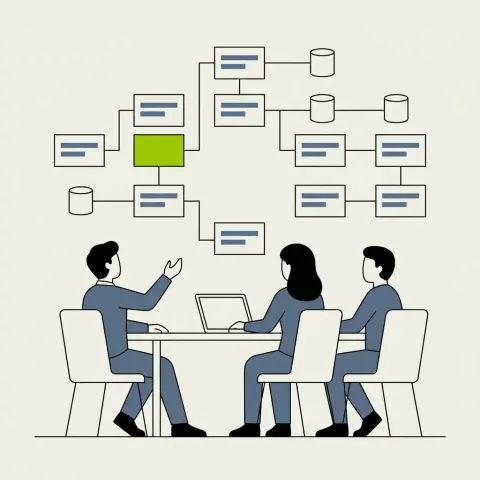
A typical week for 1 to 20 people
Sessions are set around your calendar, so the exact days move. For 21 to 50 people the same three stages run over up to two weeks, because there are more interviews, processes and handoffs to follow. Nothing runs past two weeks from the first session to the handover.
Build-ready assets, chosen for your business
Not a slide deck and not a maturity score. Each asset is something a developer, an operator or another vendor can act on. Which ones you get depends on what we find.
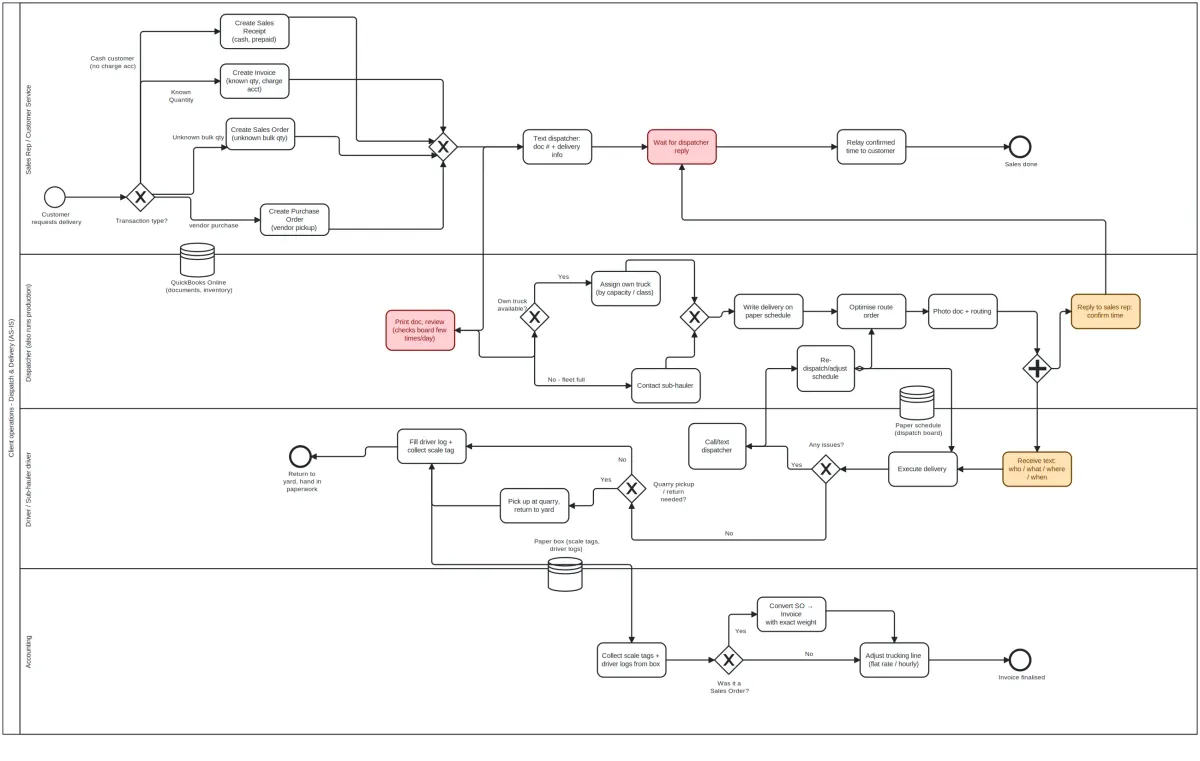
A model of how the operation runs
A process model in BPMN, one swimlane per person or team. Bottlenecks marked in red, first automation targets in amber.
A clickable prototype
A front end you can click through and react to before anyone writes production code. It settles the "that is not what I meant" conversation while it is still cheap.
A costed, sequenced roadmap
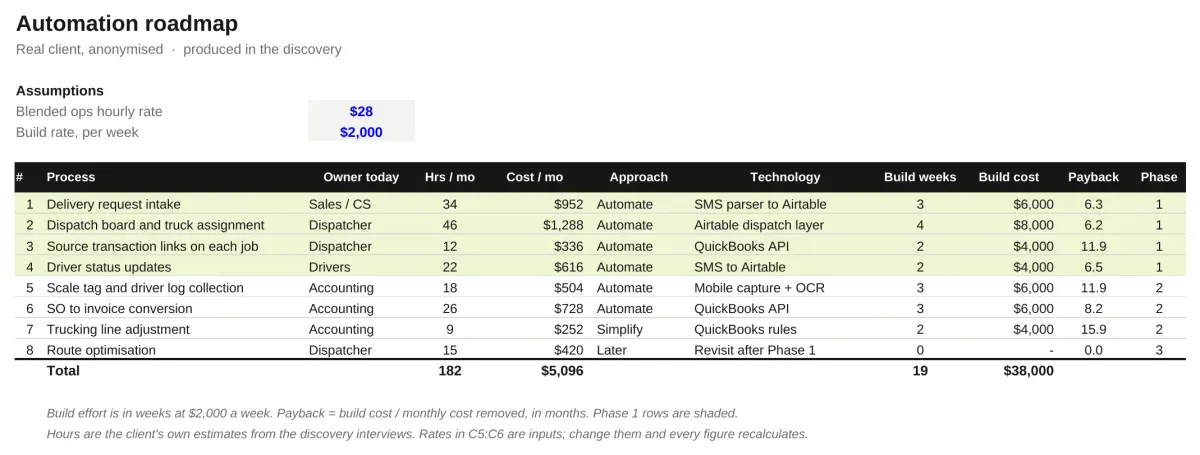
Every candidate process with its hours, cost and payback, the technology call on each, ranked so the first build pays for the second. A live spreadsheet you can keep editing.
A written proposal
Scope, milestones, the technology decision behind each choice, what is out of scope, and the price. Specific enough that another vendor could build from it.
Hours and cost behind every item
So you can judge any single item against the cost of a hire, and stop after the first if that is the right call.
Findings and recommendations
Whatever form fits best, you leave with our findings in writing. That is the one commitment in the Discovery Week Terms; the rest are examples.
How one roadmap row turns into a decision
This is the roadmap from a real engagement, reworked so we can show it. The client is not named and the numbers have been changed. The arithmetic is the point.
Read row one
- Delivery request intake takes the sales and customer service team 34 hours a month.
- At the blended rate the client gave us, $28 an hour, that is 34 x $28 = $952 a month.
- Automating it (an SMS parser feeding Airtable) is estimated at 3 weeks and $6,000.
- Payback = build cost / monthly cost removed = $6,000 / $952 = 6.3 months.
Then read the whole sheet
Rows are grouped into projects by phase. Phase 1 here is the four shaded rows, built together for $22,000. Route optimization sits in phase 3 as "later", because it only makes sense once phase 1 is live. Trucking line adjustment is marked "simplify": a rule change in QuickBooks beats a build.
The rates at the top are inputs. Change the hourly rate and every figure recalculates, so you can test the plan against your own numbers. Hours are your team's estimates from the interviews, and every figure is an estimate. To run the same math on your own processes first, use our automation ROI template.
One fixed price, set by team size
Team size decides the price because team size decides how long the gathering takes. What you get back is the same kind of work either way.
One week of gathering. Booked and paid on this page.
Up to two weeks, more ground to cover. Booked and paid on this page.
Scoped and priced on a short call, in a separate written agreement. Book a call.
- Paid when you book. Full refund any time before the gathering starts, except Stripe and currency conversion fees (approx. 3 to 5%). Email us and it is refunded the same day.
- Once the gathering starts, the work is underway: the fee stands and you keep every asset it produces.
- If we are late with the handover and still have not held it 10 business days after you email us, you can cancel for a full refund. If we cancel, you get the full fee back.
- Fixed fee. No hourly charges or expenses on top. The week runs remotely; if you want us on site, travel is agreed in writing first and paid separately.
Full terms: Discovery Week Terms. Builds after the week are priced per project; see pricing.
Book your discovery week
Six questions, then payment by card. We come back within one business day to put the gathering in the calendar.
- Under 51 peopleYou see your price and pay here.
- 51 or moreThe form routes you to a short call instead. We scope and price it there.
- Changed your mindFull refund any time before the gathering starts.*
*Except Stripe and currency conversion fees (approx. 3 to 5%). Booking is subject to the Discovery Week Terms, which you accept in the form before paying. Prefer to talk first? Book a free 30-minute call.
What happens next is your call
Paying for the week does not commit you to anything else. The proposal is priced and the prototype is clickable, so nothing about the set depends on us building it.
- Phase 1
Discovery week
We spend a week inside your operations, with the people doing the work, and find where the time and the margin go.
One week - Phase 2
The plan
A map of how your business runs today and a ranked list of what to change first, with the payback on each item. Yours to keep.
End of week one - Phase 3
Build
One process at a time, in the order the roadmap set. Each project is quoted before it starts, $6,000 to $24,000, usually three to six weeks, and scoped to pay back on its own.
Three to six weeks per project - Phase 4
Improve
The systems run on their own. If you want us to stay, we keep improving them and take on the next process.
Optional
Build with us
One project at a time, in your accounts, on your tools, documented in plain language. Most builds are an automation layer on n8n, AI agents where they do real work, or custom internal software. Stop after any project.
Build with someone else
The model, roadmap and proposal belong to you once paid. Hand them to your own team or another vendor. We would rather you came back to us, but the choice is yours.
Build nothing
If the answer is "not now", you still have a map of how your business runs and what each process costs. A priced proposal stays valid for 60 days from the handover.
What clients built after looking first
 Facility services, fire safety compliance ~230 hrs of manual operations eliminated every month
Lead intake, quotes, invoicing and certificates, automated on self-hosted n8n for a Canada-wide fire safety services company. Every lead used to be typed into three systems by hand.
Fire Plan Strategies → Financial consulting, fractional CFO 30+ hrs of founder time returned every month
Five n8n modules that read over 100 RSS feeds, score each article per client, and leave a personalized brief in the founder's Gmail drafts by 6am. He reviews and sends.
Contrail Financial → Championship ring manufacturing ~300 hrs of manual operations eliminated every month
A custom portal for coaches, customers, sales reps, plants and admins, with communication and order processing automated around it. Built for a ring maker that was running a $5M business on spreadsheets.
Signature Champions →“The team at 2V understood the project and completed it with minimal questions. Great communication, delivered on time.”
 Tim Mektrakarn
Co-Founder, Bright Defense
Automation audit, AI readiness assessment or free audit?
They answer different questions. Pick based on what the result has to do for you.
| Option | What you learn | Time | Best when |
|---|---|---|---|
| Self-check scorecard | A rough score from your own answers. Nobody looks at the work itself. | Minutes | You want a first internal conversation started |
| Free audit from an agency | A proposal. The time the agency can give for free caps how deep it goes, so it works as a sales step. | A call or two | You are comparing vendors' approaches |
| AI readiness assessment | A maturity score across data, technology, people and governance, plus gaps to close. | Days to weeks, depending on scope | The question is "can we adopt AI at all?" |
| Automation Discovery Week | Which processes to change, in what order, at what cost and payback, with a proposal you can build from. | One week (up to two for 21 to 50 people) | You know time is leaking and want to know what to build first |
| Go straight to build | Nothing new: you already have the spec. | None | A requirements document or someone else's roadmap already exists. See the second track on pricing. |
What the audit looks at
The same areas a good readiness assessment covers, judged against specific processes rather than the whole company in the abstract.
| Process | How each job really moves, step by step, and where it waits or gets retyped |
| Data | Where the records live, who keeps them right, what has to be copied by hand |
| Systems | Which tools have APIs or exports, what to connect, what to replace |
| People | Who holds each process, who decides, what stays with a person by design |
| Governance | Access, approvals, and where AI may act alone versus where a person signs off. For a public reference on AI risk, see the NIST AI Risk Management Framework |
| Value | Hours a month, cost a month, build cost and payback, per item |
Ranked by payback
A score tells you where you stand. It does not tell you which process to fix on Monday. We skip the score and rank processes by what they cost you and what fixing them costs, because that is the decision you actually have to make.
A checklist for any automation audit
- Did someone talk to the people doing the work, as well as the managers?
- Is every recommendation tied to a named process with hours and cost?
- Is the order explained, with the payback on each item?
- Can you click through the proposed fix before paying for the build?
- Is the build priced, with what is out of scope written down?
- Do you own the output, and could another vendor build from it?
- Was "do nothing here" allowed as an answer?
If AI is on your list, our guide to AI agents for business covers where they earn their place. For wider advice on what to automate, see AI automation consulting and business process automation.
Honest outcomes, and what happens to your data
When the answer is no
The roadmap may say some or all of your processes are not worth automating. That is a valid result, it does not change the fee, and you keep every asset. A week that talks you out of a bad build has done its job.
Six hours, and only six
The ask on your team is about six hours, all in the gathering. Name one person who knows how the business runs and can make decisions, and keep them reachable for follow-up questions. That is all we need.
Your data stays yours
We ask for the least access that works, view-only where possible, and you can remove it at any time. Sessions are recorded and used only for your discovery week. We do not use your information to train AI models, we delete or return it within 30 days on request, and we will sign an NDA or a data processing agreement if you need one. We never name you as a client without written permission.
Questions people ask first
What is an automation audit?
A structured look at how your business runs today, done to find the manual work worth automating and to price it. Ours is the Automation Discovery Week: one week with your team, then a costed, sequenced roadmap and a written proposal you can build from with us or with anyone else.
How much does an automation audit cost?
With us, $2,000 for a business of 1 to 20 people and $4,000 for 21 to 50, fixed, paid when you book. Above 50 people we scope and price it on a short call. Team size sets the price because it sets how long the gathering takes.
How long does it take, and how much of our time?
One week for 1 to 20 people, up to two weeks for 21 to 50. Your team spends about six hours in total, all of it in the gathering sessions. Everything else happens on our side.
Is this an AI readiness assessment?
It covers the same ground where it matters: your data, your systems, your people and the rules around them. The difference is the output. You get a ranked list of specific processes with the hours, cost and payback of each, and AI shows up on it only where it does real work.
Can I pay for the week right here?
Yes. Answer the questions in the form, accept the terms, and pay by card at the end. You get a Stripe receipt immediately and we come back within one business day to book the gathering.
What if we change our mind after paying?
You get your money back any time before the gathering starts, except Stripe and currency conversion fees (approx. 3 to 5%). Email weare@2vmdls.com and it is refunded the same day. Once the gathering has begun the work is underway, so the fee stands and you keep every asset it produces.
What if the roadmap says we should not automate anything?
Then it says that, and you keep the assets anyway. A "not worth automating" finding is a valid result and does not change the fee. We would rather tell you at the handover than sell you a build that does not pay back.
Do we need our own tech team?
No. The engineers, the analyst and the support are ours. Your side needs one person who knows how the business runs and can make decisions.
Find out what a week of your team’s time is worth.
One week inside your operations, $2,000 for a team of 1 to 20. You keep the map and the costed plan whether you build with us, with someone else, or not at all.