
An AI automation consultant that also builds what it recommends.
For owners of businesses with 5 to 50 people. We spend a week inside your operations, hand you a costed plan with the payback on each item, then build it one process at a time. Or you take the plan to someone else.
An AI automation consultant works out which manual work in your business is worth automating, with what, and in what order, then hands you the plan. At 2V the consulting is the discovery week and the roadmap it produces. The difference from a pure advisor is that we then build it; the difference from a development shop is that we look before we quote.
- Who it is for
- Businesses past $1M in revenue, usually 5 to 50 people, with no in-house automation team
- Where it starts
- Automation Discovery Week: $2,000 for 1 to 20 people, $4,000 for 21 to 50
- Your team’s time
- About six hours, all of it during the gathering
- What you get
- A model of how the work runs today and a roadmap with hours, cost, approach and payback per item
- Then
- Builds at $6,000 to $24,000 each, three to six weeks, priced before they start. Optional.
You know time is leaking. You do not know where first.
Every vendor has an AI answer
The CRM, the helpdesk and the accounting tool all sell an AI add-on. None of them can tell you which process to fix first.
A tool was bought, nothing changed
The platform is paid for, one workflow runs on it, and the expensive problem turned out to be two steps upstream.
Nobody has the whole map
With 5 to 50 people, the work is split across roles. Each person sees their part. Nobody has time to trace the handoffs end to end.
Most AI money is lost on sequence. In IBM’s 2025 CEO study, only 25% of AI initiatives had delivered the expected return (IBM, May 2025). Consulting exists to pick the right first move.
What an AI automation consultant does
The work splits into two halves. The first half is analysis: sitting with the people who do the work, tracing real jobs from start to finish, measuring where hours and errors pile up, and deciding which process to touch first. The second half is implementation, and it is not always a build. It can be:
- Building: an automation layer on n8n, an AI agent, or a custom internal tool when nothing off the shelf fits.
- Installing: a product that already does the job for a subscription. Saying so is worth more to you than a build.
- Configuring: software you already pay for and barely use. A lot of payback sits there.
- Training: sometimes the process is fine and nobody was shown how the tool works.
Most pure advisors stop after the first half and hand you a document. Most development shops and tool resellers skip it and quote whatever you asked for. We do both halves, and we keep them separate so you can stop in between.
| Who you hire | Starts with | Ends with | The risk |
|---|---|---|---|
| Pure AI advisor or strategy firm | Interviews and workshops | A roadmap or slide deck | Nothing gets built, or the plan cannot be built for the budget |
| Development shop or tool reseller | Your request, or their product | Whatever was asked for | A good build of the wrong process |
| 2V: consultant who also builds | A week inside your operations | A costed roadmap, then working systems one at a time | We are not neutral: we would like to build it. The plan is yours either way. |
Consulting first, then build in phases
Phases one and two are the consulting. Phase three is optional and priced per project.
- Phase 1
Discovery week
We spend a week inside your operations, with the people doing the work, and find where the time and the margin go.
One week - Phase 2
The plan
A map of how your business runs today and a ranked list of what to change first, with the payback on each item. Yours to keep.
End of week one - Phase 3
Build
One process at a time, in roadmap order. An automation layer on n8n, custom software on Laravel, or AI agents where a model does real work. Each one is scoped to pay back on its own.
Three to six weeks per project - Phase 4
Improve
The systems run on their own. If you want us to stay, we keep improving them and take on the next process.
Optional
What a good consultant should hand you
If an engagement ends with a list of tool logos, you bought a sales pitch. Ask for these.
- A model of how the work runs today. Every actor, every handoff, where work waits and where data gets retyped. Ours is a BPMN process model with bottlenecks marked.
- A roadmap with a row per process. Owner, hours a month, cost a month, approach, technology, build cost and payback in months. Sequenced so the first build pays back first.
- The things not to automate. Rows marked "simplify" or "later". A consultant who has never told a client no is selling scope.
- A written proposal for the first build. Scope, milestones, the technology decision, what is out of scope, and the price.
- Something you can take elsewhere. The plan should be specific enough that another vendor, or your own developer, could build from it. Ours is yours whatever you decide.
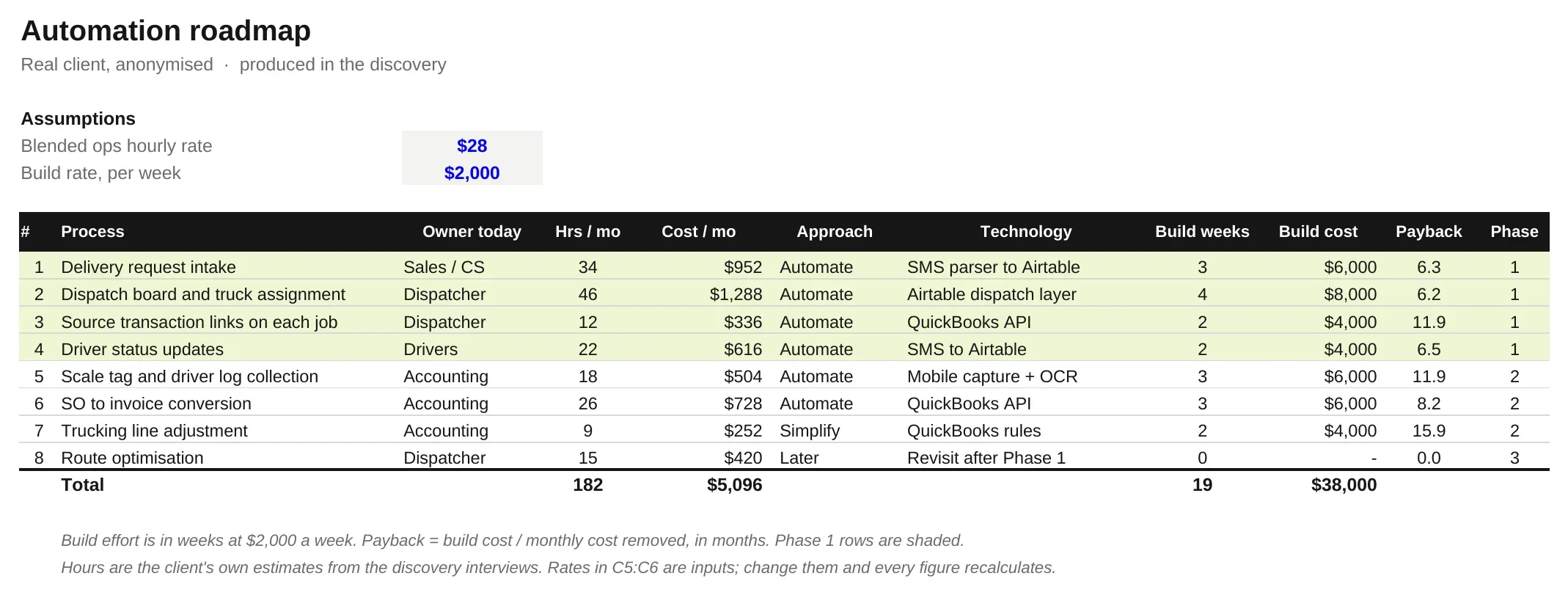
Reading one row
Row 1, delivery request intake: 34 hours a month at a blended $28 an hour is $952 a month of staff time. The build is priced at $6,000. Payback is $6,000 divided by $952, or 6.3 months. Route optimisation, row 8, scored worse and waits until the first phase is live. These are the client’s own hour estimates from the interviews, and the spreadsheet recalculates when you change the rate. Want to run the same math on your own processes? Use our automation ROI template.
What happened after we looked first
- 230hrs of manual operations removed every month Fire Plan Strategies
- 2days time to payment, down from 14 Fire Plan Strategies
- ~300hrs of manual operations removed every month Signature Champions
- 360+hrs a year of founder time returned Contrail Financial
From the map to working systems
 Facility services, fire safety compliance ~230 hrs of manual operations eliminated every month
Lead intake, quotes, invoicing and certificates, automated on self-hosted n8n for a Canada-wide fire safety services company. Every lead used to be typed into three systems by hand.
Fire Plan Strategies → Financial consulting, fractional CFO 30+ hrs of founder time returned every month
Five n8n modules that read over 100 RSS feeds, score each article per client, and leave a personalized brief in the founder's Gmail drafts by 6am. He reviews and sends.
Contrail Financial → Championship ring manufacturing ~300 hrs of manual operations eliminated every month
A custom portal for coaches, customers, sales reps, plants and admins, with communication and order processing automated around it. Built for a ring maker that was running a $5M business on spreadsheets.
Signature Champions →Fire Plan Strategies had tried three fixes before us: native integrations, Zapier and an in-house Power BI setup. Each fixed a tool, none fixed the process. Twelve weeks from discovery to production, the whole automation layer ran on self-hosted n8n.
“This is music to my ears. Our accountant is definitely going to love this because she's not going to have to do invoices anymore. The admin staff is also going to love it because they're not going to have to manually do each one of those certificates.”
 Mariano Velazco
Managing Partner, Fire Plan Strategies · Read the case
“The team at 2V understood the project and completed it with minimal questions. Great communication, delivered on time.”
 Tim Mektrakarn
Co-Founder, Bright Defense
When you need an AI automation consultant, and when you do not
Skip the consultant if
- You already know which process to fix and roughly how. Hire someone to build it.
- The work touches one tool and one person, and someone on your team has a few spare hours a week to learn it.
- You only want AI for writing, summaries or brainstorming. A ChatGPT or Claude seat and an hour of training will do.
- You already have a specification or a roadmap from someone else. We price that build directly, no discovery needed (see pricing).
Hire one if
- Time is leaking in several places and you cannot say which costs the most.
- The process crosses three or more systems or roles, so nobody sees all of it.
- A wrong first build would hurt: money, customers or a compliance deadline sit in the process.
- You need the numbers to survive a conversation with a partner, a board or your accountant before you spend.
For a team of 5 to 50 people
This is the size where consulting pays most and is sold worst. Under five people, the owner usually sees every handoff and a well-configured tool goes a long way. Between 5 and 50, work is split across roles, the same order gets typed into two or three systems, and one person often holds a process in their head. Enterprise firms are built for programs that run for months. A small team needs someone who traces the real jobs in days.
So we price by team size, because team size sets how long the tracing takes: one week for 1 to 20 people, up to two weeks for 21 to 50. Your side gives about six hours, all during the gathering, and needs one person who knows how the business runs and can make decisions. You do not need a tech team.
The alternative is doing the analysis in-house. The median US management analyst earns $101,860 a year before benefits (BLS, May 2025). That makes sense once automation runs across the whole company and needs constant attention. For the first two or three processes, a bounded engagement is cheaper.
How to find the processes worth automating
Score each candidate from 0 to 2 on six questions. It takes ten minutes per process and kills most bad ideas before anyone quotes them.
| Question | 0 | 1 | 2 |
|---|---|---|---|
| Hours a month, across everyone who touches it | Under 5 | 5 to 20 | Over 20 |
| How often it runs | Monthly or less | Weekly | Daily or per order |
| Can you write the rules down? | No, it is judgment every time | Mostly, with known exceptions | Yes, fully |
| Where the input arrives | Phone calls, paper | Email, PDFs, free-text forms | Already in a system with an API or export |
| What a late or wrong result costs | Nothing much | Rework | Cash, customers or compliance |
| Is there a named owner? | No | Shared between people | One person who can decide |
The decision rule. 9 or more: it belongs on the roadmap, priced. 5 to 8: simplify or configure it first; it may not need a build at all. Under 5: leave it. And whatever the total, a 0 on ownership comes first: name the owner before anyone builds, because an automation without an owner breaks quietly and stays broken.
Then price the top candidates. Hours a month times a loaded hourly rate gives the monthly cost. The build price divided by that monthly cost gives the months to pay back. Sequence by payback. This is our working rule of thumb, and in the discovery week we fill these numbers from the people doing the work.
AI, workflow automation or RPA: which one, step by step
Most processes need a mix. The rule: steps you can write down as rules go to plain automation; steps that need someone to read messy input and decide go to a model.
| Approach | What it does | Use it when | Example |
|---|---|---|---|
| No build: install, configure, train | Uses a product or a feature you already pay for | Something off the shelf already does the job | Turning on the CRM’s own follow-up sequences |
| Workflow automation (n8n, Zapier, Make) | Moves data between tools through their APIs, by fixed rules | The rules can be written down and the tools have APIs | A paid invoice in QuickBooks triggers the certificate |
| RPA (software robots) | Clicks through a screen the way a person would | An old system has no API and cannot be replaced yet | Copying orders out of a legacy desktop app |
| AI step inside a workflow | A model reads unstructured input and returns structured output | The input is email, PDFs or free text and the judgment is repetitive | Pulling vendor, amount and due date out of supplier invoices |
| AI agent | A model chooses which tools to call and in what order | The steps depend on what it finds, and a person approves risky actions | Triage of support tickets with a drafted reply for review |
A consultant who reaches for a model on every step is selling the category. Most of what slows a small company down is data retyped between two systems or an approval stuck in an inbox, and that needs plain integration. More on where agents earn their place in AI agents for business, and on the tool most of our automation layers run on in what is n8n.
Five questions to answer before you spend anything
1. Who owns the process?
One person who knows how it runs today and can say yes or no to a change. Without that person, no consultant can help.
2. Is there enough volume?
Count the hours a month across everyone who touches it. A two-hour monthly task rarely pays for a build, however annoying it is.
3. Where does the data live?
Name the systems, and check whether each one has an API or an export. Scattered spreadsheets are fine. Data nobody can reach is not.
4. Can the rules be written down?
If two people do the same task differently, agree the right way first. Automating a disagreement only makes it faster.
5. Who approves when it is wrong?
Anything that touches money, customers or compliance needs a person who signs off, at least at the start. Decide who before the build.
Not sure yet?
That is what the gathering is for. We answer these with your team in about six hours, then score and price every candidate. How the discovery week runs.
What AI automation consulting costs
| Stage | Price | Length | What you hold at the end |
|---|---|---|---|
| Discovery week, 1 to 20 people | $2,000 | One week | Process model, costed roadmap, proposal, often a clickable prototype |
| Discovery week, 21 to 50 people | $4,000 | Up to two weeks | The same, across more roles and handoffs |
| 51 people or more | Short call first | Scoped on the call | n/a |
| Each build project | $6,000 to $24,000 | three to six weeks | A working system in your accounts, documented |
| Maintenance | Optional, quoted once a build is live | n/a | Whatever you want covered |
The discovery week is a fixed fee, paid when you book, with a full refund any time before the gathering starts (except Stripe and currency conversion fees, about 3 to 5%). Builds are priced per project before they start, so the number you approve is the number you pay. Where a project lands in the range depends on how many systems it touches, how much is built rather than configured, and how fast you want it. Most clients do two or three projects in the first few months, and stopping after one is a normal outcome. Full detail on the pricing page.
How others price it. Across the market you will see three shapes: hourly advisory, a fixed-fee assessment, and a monthly retainer. None is wrong. What matters is what you hold at the end, whether the assessment is priced separately from the build, and whether a retainer starts before anything has been scoped. A finished build should run without the consultant, so there should be nothing monthly to buy on day one.
How to choose an AI automation consultant
The title is not regulated, so the label tells you nothing. Ask these before you sign:
- What did you build in the last year for a company our size, and can I speak to that client?
- What would you tell us not to automate?
- Who does the work: the person on this call, or someone else? Name them.
- What do we hold at the end of the consulting part, and could another vendor build from it?
- Who maintains it after you leave, and does it run in our accounts?
| Red flag | What it usually means | What to ask for instead |
|---|---|---|
| Recommends a tool on the first call | A reseller or partner fee is driving the advice | Look first, then a technology call per process, including "buy a product" |
| Retainer before any scope | Open-ended billing is the business model | A fixed fee for the assessment and a fixed price per build |
| Strategy only, no implementation | The plan has never had to survive a build | Examples of systems they shipped and still run |
| Every process gets AI | Selling the category | Plain automation where rules work, a model only where judgment is needed |
| Nothing on the list is "no" | Optimizing for scope | Items marked simplify, later or not worth it |
| Runs on their platform | You cannot leave without rebuilding | Built in your accounts, documented, owned by you |
We consult and we build, which cuts both ways. Our advice comes from what we know ships, and we are not a neutral party. We are a certified n8n Expert Partner and most of our automation layers run on n8n; the roadmap still records the technology call on every row. If you want an advisor with no build arm at all, that is a fair choice. Our list of the best AI automation consultants covers that option too.
Questions people ask first
What does an AI automation consultant do?
An AI automation consultant looks at how your business runs, finds the manual work that costs the most, and decides what to automate, with what, and in what order. A good one hands you a costed roadmap with the payback on each item. Some stop there; we also build it, one process at a time.
How much does an AI automation consultant cost?
With us, the consulting part is the Automation Discovery Week: $2,000 for 1 to 20 people, $4,000 for 21 to 50, a short call first above 50. Each build after that is a fixed-price project of $6,000 to $24,000, quoted before it starts. Elsewhere you will see hourly advisory, fixed-fee assessments and monthly retainers; ask which one you are buying and what you hold at the end.
Do I need an AI consultant for a small business?
Not always. If you already know which process to fix and how, hire someone to build it and skip the consulting. A consultant earns the fee when your team of 5 to 50 is losing time in several places and nobody has the map of where it goes. We work remotely, so location does not matter.
What are examples of AI automations?
Reading invoices, forms or contracts and pushing the fields into your accounting system or CRM. Sorting inbound email and tickets and drafting a first reply for a person to approve. Answering staff questions from your own documents, with sources. Most useful automations are mostly plain workflow with one AI step in the middle.
Can I do AI automation for free?
The tools can cost little or nothing to start: n8n can be self-hosted, and most platforms have free tiers. The real cost is the time of someone who learns the tool, maps the process, handles the exceptions and fixes it when an API changes. If one person on your team has that time and the process touches one or two systems, do it yourself.
What is the difference between an AI consultant and an AI implementation consultant?
The titles are not regulated, so they overlap. In practice an AI consultant or advisor recommends and an AI implementation consultant builds and integrates. Ask what the engagement ends with: a document, a working system, or both.
Who are the big 4 in AI consulting, and do we need one?
The phrase usually means Deloitte, PwC, EY and KPMG, which all sell AI consulting to large organizations. A company of 5 to 50 people rarely needs that scale. You need someone who will sit with the people doing the work, name the two or three processes worth fixing, and build them in weeks.
Will we have to replace the software we already use?
Usually not. Most of what we build connects the tools you already run, and some of the payback comes from configuring software you already pay for. Where a tool genuinely holds you back, the roadmap says so and prices the change. Everything runs in your accounts and you own it.
Find out what is worth automating, in one week.
One week inside your operations, $2,000 for a team of 1 to 20. You keep the map and the costed plan whether you build with us, with someone else, or not at all.