
Custom business software for the way your business actually runs
Internal CRMs, client and partner portals, operations dashboards and quoting tools, built when no product fits your process. For businesses past $1M in revenue, one process at a time, in your accounts.
Custom business software is software built for one company's way of working, instead of a product you bend your process around. We build it for established businesses when buying, configuring or connecting existing tools will not do the job: an internal CRM, a portal for clients or partners, an operations dashboard, a quoting tool. Each build covers one process, costs $6,000 to $24,000, and belongs to you.
- Who it is for
- Running businesses past $1M in revenue whose process no product fits. Not startups looking for an outsourced product team
- What we build
- Internal CRMs, client and partner portals, operations dashboards, quoting and ops tools, systems of record
- Stack
- Laravel first (certified Laravel partner since 2022), React where the front end needs it, n8n around it
- Project price
- $6,000 to $24,000 each, three to six weeks, priced before it starts
- Where it starts
- Automation Discovery Week, $2,000 for 1 to 20 people, or a spec you already have
- Who owns it
- You. Code, hosting and data in your accounts, documented and handed over
The process lives in the gaps between your tools
Five subscriptions, one spreadsheet
You pay for a CRM, an invoicing tool and a project tool, and the real status of an order is still in a sheet someone updates by hand.
Your clients ask by email
Customers, partners or reps want to see their order, their documents or their payments. The only way is to ask a person on your team.
The product almost fits
The CRM handles 80 percent of the process. The other 20 percent, the part that makes your business different, runs on workarounds.
If one of these is your biggest leak, a custom tool may be the fix. Often it is not, and a cheaper option does the job. The table further down shows how we decide.
Internal software for a business that already runs
Tools your staff, clients and partners use every day to run the operation.
Internal CRMs
A pipeline, account record and task flow shaped around how you sell and deliver, when Salesforce or HubSpot would need more workarounds than features. Connected to your accounting and email.
Client and partner portals
Logged-in views where customers, dealers or reps order, track status, pay and get answers without emailing your team. Each user sees only their own data.
Operations platforms
One record for every order, job or contract, replacing the spreadsheet that holds the business together. The custom ERP layer for one operation, with accounting left where it is.
Quoting and ops tools
Calculators, configurators, approval flows and admin panels built on your rules and your data, so the quote is right the first time.
Operations dashboards
The numbers from your CRM, accounting and project tools in one view, read from the same source so they agree. Built custom when a BI tool does not fit the audience.
APIs and connectors
The connections you assumed existed but do not: your system to a partner API, a contract system or a payment provider, with retries and logs.
Buy, configure, low-code, n8n or build: how we decide
Custom software is the last option on this list. Most of what businesses call a software problem is a configuration or connection problem, and those are cheaper to fix.
| Option | Right when | Breaks when | What it costs you |
|---|---|---|---|
| Buy a product | Your process is close to the industry standard: a normal sales pipeline, normal invoicing, normal projects. | Your process is the thing that makes you different, or the product needs people retyping data around it. | A subscription per user. Salesforce lists Sales Cloud editions from $25 to $550 per user per month. |
| Configure what you own | The tool can already do it and nobody set it up, or nobody was shown how. | The data model itself is wrong for your business: one order with fifty buyers, a contract per sale. | Hours of setup and training. Often the cheapest win in a discovery week. |
| Low-code (Retool-style) | An internal admin screen over a database you already have, used by your own staff, built by someone technical on your side. | Outside users log in, money moves through it, or logic grows past what the builder can keep tidy. | Per-user pricing plus whoever builds it. Retool Business lists $50 per builder and $15 per internal user a month, billed annually. |
| n8n automation layer | The tools are fine. The problem is moving data between them: retyping, copying, chasing, reporting. | People need a screen to work in that none of your tools provide. | One project, then your own hosting. See our n8n automation agency page. |
| Custom build | No product fits the process, several user groups need different views of the same record, or the workaround costs more than the build. | The process is still changing every month. Settle it first, then build. | $6,000 to $24,000 per project with us, plus hosting in your account. Maintenance optional. |
Third-party prices from Salesforce Sales Cloud pricing and Retool pricing, checked November 2026. Vendors change prices; check the current page.
Looking for a Retool agency?
Retool is a good fit for internal admin screens your own team builds and runs. Retool is not what we lead with. When the discovery week shows a low-code tool is the right answer, the roadmap says so and names it, and your team or a Retool specialist can build it. We build in code when outside users, payments or contracts are involved, or when per-user pricing grows faster than the team.
Most clients end up with a mix
Signature Champions got a custom portal as the system of record, with QuickBooks, HubSpot, ShipStation, SendGrid and Twilio kept around it. The custom part is only the piece no product covered. The rest is connection work, the kind described on our business process automation page.
What a custom system of record did for a $5M business on spreadsheets
- ~300hrs of manual operations removed every month Signature Champions
- $100K+ saved in annual operating cost Signature Champions
- 100% user adoption within two months Signature Champions
- 80+ manual email scenarios replaced by templates Signature Champions
One custom Laravel portal with five views: coaches collecting team orders, customers designing a ring with a live preview, sales reps tracking their accounts, manufacturing plants pulling production-ready data, and admins. Built over 24 months, with automated testing on every release and a development, staging and production pipeline.
Custom software we built and still stand behind
 Championship ring manufacturing ~300 hrs of manual operations eliminated every month
A custom portal for coaches, customers, sales reps, plants and admins, with communication and order processing automated around it. Built for a ring maker that was running a $5M business on spreadsheets.
Signature Champions → Document automation, SaaS 2 hrs to produce a 78-page conference program on it, down from 1 week
Our own product. Rows from Airtable or Google Sheets become finished Google Slides and Docs files on templates a designer built, delivered to Google Drive with a PDF beside every file.
SourceToDocs → Warranties and protection plans 15 min between each sync of orders and customer details to HubSpot
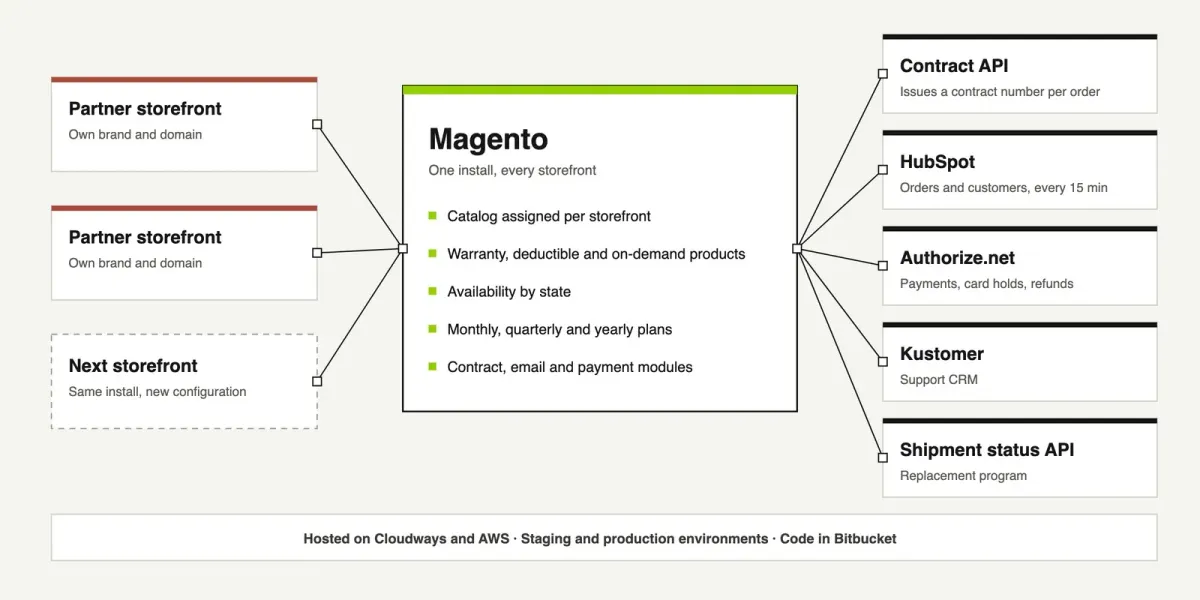
A multi-storefront Magento platform that issues warranty contracts from the order itself, syncs every order to HubSpot every 15 minutes, and automates card holds, refunds and contract retries.
OnPoint Warranty →“300+ hours of manual work eliminated every month. Recurring processes that ate our team's time are gone entirely.”
 Kyle Winchell
Signature Champions · Read the case
“2V created a great platform that worked well without bugs. They were friendly, down-to-earth, and hardworking.”
 Georgi Metodiev
Founder, Recruitica · Read the case
Laravel first, React where it earns its place
We have been a certified Laravel partner since 2022, and Laravel is still what we reach for when a workflow tool will not carry the weight. It gives a business application what it needs out of the box: authentication, roles, queues, scheduled jobs, mail and a clean database layer. A competent PHP developer anywhere can maintain it after us.
Around it, the usual parts: PostgreSQL for the data, Filament or Laravel Nova for admin panels, queue workers for heavy jobs, and React or similar for screens that need to feel like an app, such as a configurator with a live preview. We have also shipped React with a NestJS back end on AWS where the project called for it (Recruitica).
Two things sit next to the code. n8n handles the orchestration between your systems where a workflow is clearer than code: the trigger, the routing, the retries. If n8n is new to you, start with what n8n is. AI goes in only where it does real work, such as reading a document or triaging a request, with the rules about money and customers kept in code. Our AI agent development page covers how.
We run our own product on the same stack. SourceToDocs is Laravel, Filament and PostgreSQL with queue workers, and it took a 78-page conference program from one week of work to two hours.
How a build is scoped and priced
A running business cannot stop for a nine-month project. So we do not sell one.
Track one: one process at a time
We start with a week inside your operations. The discovery week maps how the work moves today, and the roadmap prices every candidate, custom software or not, with the payback on each. You usually also get a clickable prototype, so your team can click through the screens before anyone writes production code.
Then we build the first item. Each project is $6,000 to $24,000, typically three to six weeks, quoted as a project rather than by the hour, so the number you approve is the number you pay. It is scoped to pay back on its own, and you can stop after any of them. A portal or internal CRM grows the same way: the first project ships the screens and records for one process, the next adds the next process to the same codebase.
Track two: you already have a spec
Some work arrives specified: a requirements document, a design, an RFP, or a roadmap from someone else's discovery. Then we skip the week and price the build directly. We read the specification first and tell you what is missing before quoting. That part is free.
Milestones, from the spec. We price each stage, you approve them one at a time, you know the total before we start, and you can stop at a milestone boundary. This fits most build-to-spec work, including long ones.
Time and materials. Only when the scope will genuinely move, such as research-heavy work, and fixed milestones would mean padding the estimate. We bill the time and report against it.
- Phase 1
Discovery week
We spend a week inside your operations, with the people doing the work, and find where the time and the margin go.
One week - Phase 2
The plan
A map of how your business runs today and a ranked list of what to change first, with the payback on each item. Yours to keep.
End of week one - Phase 3
Build
One process at a time: an internal CRM, a portal, a dashboard or a quoting tool, built on Laravel in your accounts, $6,000 to $24,000 per project. Each project is scoped to pay back on its own.
Three to six weeks per project - Phase 4
Improve
The systems run on their own. If you want us to stay, we keep improving them and take on the next process.
Optional
What decides where a project lands in the range: how many systems it touches, how much has to be built rather than configured, and how fast you want it. The full model is on the pricing page.
What a custom CRM costs, and what drives it
Published estimates for a custom CRM vary by an order of magnitude, because "a CRM" can mean a contact list with a pipeline or the system your whole company runs on. The cost follows the scope. These are the things that move it:
- Kinds of users. Staff only is one thing. Staff plus customers, reps or partners, each with their own view and permissions, multiplies the screens and the testing.
- Systems it touches. Accounting, email, phone, e-signature, payments. Each connection needs mapping, error handling and a decision on which system owns which field.
- Data you bring. Moving years of records out of an old CRM or spreadsheets, and cleaning them, is real work and often underestimated.
- Rules that are yours. Pricing, approvals, commissions, territories. The more of your logic it carries, the more it is worth and the more it costs.
- Reporting. A few fixed views are cheap. A reporting layer leadership trusts takes metric definitions agreed up front.
With us, a CRM is scoped like everything else: one process per project at $6,000 to $24,000, or milestones from a spec for a full replacement. If what you need is automation inside a CRM you keep, that is a different job: see sales automation.
The arithmetic of per-user pricing
A 30-person company where everyone works in the CRM, at list prices checked November 2026:
- A $100 per user per month CRM edition: 30 × $100 × 12 = $36,000 a year, before configuration or add-ons.
- Retool Business, 2 builders and 28 internal users: (2 × $50 + 28 × $15) × 12 = $6,240 a year, before anyone builds the screens.
- A custom build: a one-off project price per process, then hosting in your own account and changes when you want them.
Seat pricing alone is not a reason to build. A product also ships updates, mobile apps and support you would otherwise pay for. Compare over three years, and count the hours your team spends on workarounds, which is usually the bigger number. The roadmap does that comparison per process. Our automation ROI guide shows the method.
Ownership, hosting, documentation and handover
The real risk of custom software is depending on the person who wrote it. This is what you should receive, from us or from anyone you hire.
- The source code. Handed over with its history and documentation, so another developer can pick it up.
- Hosting in your account. Your cloud or server, your domain, your database. There is no 2V platform in the middle.
- Staging and production. Changes are tested on a copy before they reach the live system.
- Tests, logging and monitoring. So a failure shows up as an alert before a customer notices.
- Plain-language documentation. A system overview, every integration, and the admin tasks your team does day to day. OnPoint Warranty got each admin task with a screen recording.
- A team that knows it. Your staff trained on the admin side, and a codebase another Laravel developer can pick up.
Maintenance is optional
A finished build runs without us, so there is nothing to buy when you start. If you later want us watching it, improving it or taking on the next process, we quote that once something is live, based on what you want covered.
Security and data
We work with the least access the job needs. Customer data stays in your systems. Where a build uses AI, we use providers whose terms exclude your traffic from model training, or a model you host yourself when confidentiality requires it.
Freelancer, in-house team or a firm like ours
| Option | Good for | Watch out for |
|---|---|---|
| Freelance developer | A small, well-defined tool with one clear owner on your side. | One person holds all the knowledge. If they move on, so does your ability to change the system. |
| In-house developer | Software that changes every week and is core to what you sell. | A full salary for a tool that may need a few weeks of work a year once built. Hard to hire for one stack. |
| Large custom software development company | Big product builds with a long specification and a large budget. | Discovery phases measured in months, and a team sized for the project rather than for your operation. |
| 2V Automation | Internal software for a running business, decided after looking at the whole operation, built one process at a time. | We do not do staff augmentation, embedded engineers or startup products from an idea. If that is what you need, we will say so on the call. |
Seven years as an engineering team, then a narrower question
We started in 2016 as 2V Modules, a software development outsourcing shop, and spent seven years building other companies' software. We kept seeing the same thing: the software was fine, and the process around it was the expensive part. In 2023 we became 2V Automation and stopped taking general development work.
The engineering did not go anywhere. We still build custom software, as a certified Laravel partner, but only when it is the right answer for your operation. That is why we start by looking at how the business runs rather than by quoting a build. Our story
Questions people ask first
What is custom business software?
Software built for one company, around how that company works, instead of a product sold to thousands of companies. Bespoke software means the same thing. For a running business it is usually an internal CRM, a client or partner portal, an operations dashboard or a quoting tool that sits on top of the products you already pay for.
What are examples of custom business software?
A portal where coaches, customers, sales reps and plants share one order record (Signature Champions). A storefront platform that issues a warranty contract for every order (OnPoint Warranty). A document generator that turns spreadsheet rows into finished slides and PDFs (SourceToDocs). Most businesses still run off-the-shelf accounting, email and project tools next to these, and they should.
How much does custom business software cost?
With us, $6,000 to $24,000 per project, one process at a time, priced before it starts. A larger system is several projects in a row, or a build priced by milestones from your specification. What moves the price: how many systems it touches, how much is built rather than configured, how many kinds of users it serves and how fast you want it. The pricing page has the whole model.
When should we build custom software instead of buying a product?
When you have tried the products and the process still runs on spreadsheets, retyping and email around them. Before that, configure what you own or connect it with an automation layer. If a subscription solves it, we say so: that is a better result for you than a build.
Can I build my own business software with no-code or AI tools?
Yes, for simple internal tools: one team, one database, a few screens. Low-code tools such as Retool and AI app builders are good at that. It gets hard when outside users need to log in, when money or contracts move through it, or when it must stay correct as your other systems change. That is where an engineered build with tests and staging pays for itself.
Is custom software worth it for a small business?
It can be, if the process it fixes costs more than the build. We work with businesses past $1M in revenue, and the discovery week ($2,000 for 1 to 20 people) prices each candidate against the time it removes. Sometimes the answer is a cheaper tool or a configuration change, and the roadmap says that.
Do you build custom ERP systems?
We build systems of record for one operation: orders, production, payments and the people around them, like the Signature Champions portal. We do not rebuild accounting. That portal still sends finance data to QuickBooks. Replacing a full ERP suite is rarely the cheapest fix, and we will tell you if it is not.
Do we own the code, and what happens if we stop working with you?
You own it. It runs in your accounts, on your hosting, with the source code handed over and plain-language documentation. If we part ways, it keeps running and another developer can pick it up. There is no 2V platform in the middle.
Find out whether you need custom software at all.
One week inside your operations, $2,000 for a team of 1 to 20. The roadmap tells you what to buy, what to connect and what is worth building, with the price of each. You keep it whatever you decide.