E-commerce Automation - For DTC Brands That Outgrew the Default Stack
For $1M-$50M GMV brands where ops live between Shopify admin, a 3PL portal, the helpdesk, Klaviyo, and three spreadsheets. We install the automation layer that turns those tools into one operating system - without ripping Shopify out.
Our e-commerce clients


Shopify ships great defaults. Then you grow past them.
One automation layer across Shopify, the marketplaces, the 3PL, and the ERP.
What we automate for e-commerce
The eight workflows that swallow ops time at $1M-$50M GMV brands. Pick the ones bleeding the most.
-

Order ops & exceptions
Address validation, fraud-hold workflow, OOS routing, partial-shipment handling, gift-order edge cases - all handled by rules + AI with a human only on the edge cases. Most brands cut order-exception handling from hours/day to under 30 min.
-

Fulfillment routing
Orders routed to the right 3PL warehouse, FBA, or in-house pick based on SKU availability, customer geo, shipping speed, and cost. Multi-warehouse splits handled automatically. Carrier selection optimized per shipment.
-

Returns & RMA flow
Customer-initiated returns through a portal, automated RMA generation, label issuance, condition-grading on receipt, and refund/exchange triggered without CS-rep keystrokes. Reason codes flow into product and merchandising reporting.
-

Post-purchase comms
Order confirmation, shipping updates, delivery, review request, replenishment reminder, win-back - orchestrated across email, SMS, and on-store messaging based on what the customer actually bought and how it shipped, not a static schedule.
-

Support ticket triage
AI triage on every inbound message - WISMO, returns, product questions, complaints - with draft replies grounded in policies and order data. Tickets route to the right team automatically; humans handle the 20% that need judgment.
-
Subscription / retention ops
Subscription billing, pause/swap logic, churn-signal detection, win-back triggers, and dunning recovery. Recharge, Ordergroove, or native - we work with what you've got.
-
Marketing → ERP data sync
Klaviyo flows triggered by ERP-side events (not just Shopify events). Ad-platform conversion events enriched with shipped, returned, and net-margin data so your acquisition reporting reflects reality, not gross top-line.
-
Inventory + reorder triggers
Demand-aware reorder points, lead-time-aware POs, multi-channel inventory sync (Shopify + Amazon + retail), and stockout alerts before the customer notices. Reduces oversells and dead stock at the same time.
Three flavors of brand we serve
-
SINGLE-CHANNEL DTC
Shopify-led brands doing $1-10M GMV. Highest-ROI starting points are usually post-purchase orchestration, returns, and support triage. Marketing-to-margin attribution often follows. -
MULTI-CHANNEL OPERATORS
Brands selling on Shopify + Amazon + eBay + retail or Walmart. The defining problem is SKU and inventory sync across channels with different APIs, fees, and SLA rules. Order ops and inventory automation drive the most recovered hours. -
SUBSCRIPTION-LED BRANDS
Recurring revenue brands using Recharge, Skio, Ordergroove, or native subs. Retention ops, churn signal detection, and dunning recovery sit on top of the standard order-ops automation layer. Daily LTV/churn dashboards become the operator's home screen.
How it worked for Signature Champions
 Championship Ring Manufacturing
 Signature Champions: From Spreadsheet Chaos to Automated Revenue
Custom software development and automation
- 300+ hrs / monthManual ops time eliminated
- No hires requiredOperational scale
"300+ hours of manual work eliminated every month. Recurring processes that ate our team's time are gone entirely."
 Kyle WinchellSignature Champions
 The E-commerce automation layer
One system, five connected modules, plus optional layers for subscription and ERP. Engineered to live across Shopify, the marketplaces, the 3PL, and the helpdesk - without replacing any of them.
The E-commerce automation layer
Connected modules that turn your stack of tools into a brand that runs as a system:
Order Ops
Address validation, fraud-hold routing, OOS handling, partial-shipment logic, and gift-order edge cases run automatically. Order exceptions land in a single ops queue with the data needed to resolve them - not a Shopify tab and a 3PL tab and a Gorgias ticket.
Fulfillment Routing
Multi-warehouse, multi-3PL routing based on real-time inventory, customer geo, shipping speed promise, and unit economics. FBA vs in-house decisions automated. Carrier selection optimized per shipment instead of per ruleset.
Support Triage
AI triage on every inbound message, grounded in order data, policies, and shipment status. WISMO answered without a human; complex tickets routed to the right team with order context attached. CS team shrinks the queue, doesn't drown in it.
Returns Pipeline
Customer self-serve RMA → label → tracked return → condition grading → refund or exchange - without a CS-rep touch on the 80% that don't need one. Reason codes feed merchandising; high-return SKUs surface before next season's buy.
Marketing Data Layer
Shopify + ERP + 3PL events normalized and fed into Klaviyo, Postscript, and the ad platforms. Conversion events enriched with shipped, returned, and contribution-margin data so acquisition reports reflect what actually shipped - not just what was ordered.
Subscription Ops
Optional module for subscription brands: churn-signal detection (skips, payment fails, ticket sentiment), win-back triggers, pause/swap orchestration, dunning recovery, and LTV-per-cohort reporting. Plugs into Recharge, Skio, Ordergroove, or native - we don't push a preferred vendor.
ERP Integration
For brands on NetSuite, Brightpearl, Cin7, or similar: bidirectional sync between Shopify, the ERP, and the 3PL so inventory, COGS, and order status agree across systems. End-of-day reconciliation runs automatically; exceptions hit a partner-review queue.
How we install it
Five-step playbook. Each phase delivers value before the next begins.
- 1
Step 1. Automation Discovery Week
One week inside your operations, mapping where ops hours actually leak - order exceptions, returns, CS, inventory chaos. Prioritized roadmap whether we engage or not.
- 2
Step 2. Roadmap Design
12-month plan ordered by ROI. Most brands start with support triage or order-exception handling - fastest payback. Returns and subscription ops follow.
- 3
Step 3. Phased Implementation
One module at a time. Each goes live and pays for itself before the next starts. Built on production infrastructure with monitoring, error recovery, and rollback - not a Shopify Flow held together with hope.
- 4
Step 4. Training and Handoff
Ops, CS, and marketing learn the exception workflows. Full docs, diagrams, video walkthroughs. The brand owns and can extend the system.
- 5
Step 5. Ongoing Monitoring
24/7 monitoring, automated error recovery, monthly optimization reviews, updates when Shopify, Klaviyo, or your 3PL ships breaking changes. SLA-based incident response.
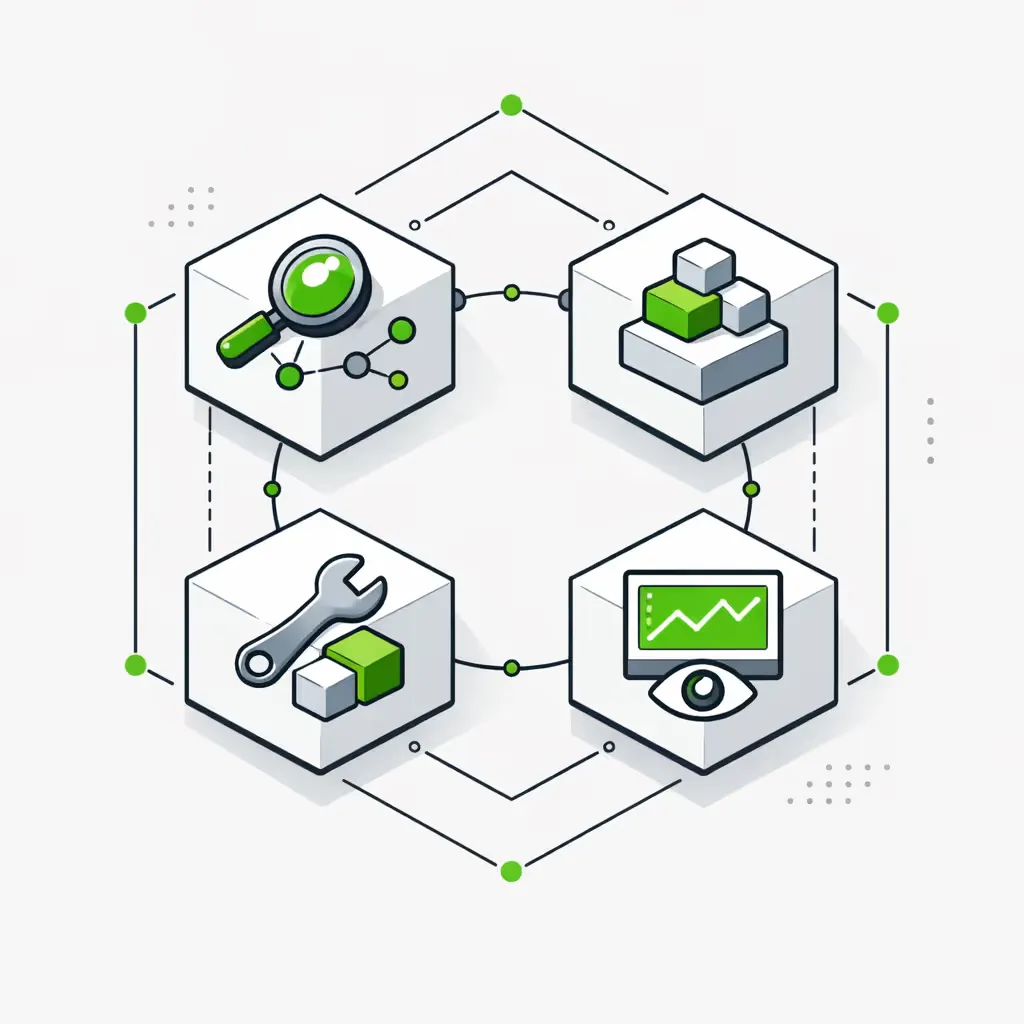
Why production-grade matters at scale
Engineering depth, not 'Shopify experts'
20+ years of senior engineering applied to e-commerce ops. We've shipped against 137 production tools. We're not a Shopify Plus agency with a Flow license - we're systems engineers who happen to ship a lot of Shopify.
No rip-and-replace
Shopify stays. Klaviyo stays. Your 3PL stays. We engineer the seams. The only thing we replace is the spreadsheet.
Multi-channel native
Amazon Seller Central API limits, Walmart Marketplace quirks, eBay's pricing rules - we've shipped around all of them in production. Multi-channel isn't an afterthought.
Your stack, not ours
ShipStation or ShipBob, Gorgias or Zendesk, Klaviyo or Postscript, NetSuite or Brightpearl - we plug in. We don't push vendors.
Retainer, not project bill
Once a build is live it runs without us. If you want us to keep improving it, we agree that separately. Shopify's quarterly API churn doesn't trigger a new SOW.
Stack we connect
We've integrated each of these in production brand environments. If your brand runs on it, we've probably already shipped against it.
137 toolsWe've integrated in production environments
STOREFRONT
MARKETPLACE
FULFILLMENT / 3PL
SUPPORT
EMAIL / SMS
ERP
REVIEWS & UGC
SUBSCRIPTIONS
Engagement
Every brand has a different stack and a different bottleneck. The shape of an engagement is consistent.
Automation Discovery Week
Builds
Ongoing
Frequently asked questions
The questions DTC operators ask us before signing the workshop.
Do we need to leave Shopify?
No. We engineer around Shopify, not against it. Shopify stays the storefront and order system of record. The automation layer handles the seams between Shopify and everything downstream - 3PL, helpdesk, ERP, marketplaces. More on how we work with Shopify here.
Can you integrate Klaviyo + Gorgias + Shopify in one flow?
Yes - that's a standard configuration. Klaviyo flows triggered by automation layer events (including ERP and 3PL events, not just Shopify), Gorgias tickets enriched with shipment data and AI triage, all running against Shopify as the system of record. The handoff between marketing, support, and ops becomes one connected pipeline.
What about Amazon Seller Central API limits?
Real and annoying. We've shipped against them in production at six-figure-monthly-order volume. Rate-limit-aware queueing, exponential backoff, and intelligent batching are first-class concerns. We're honest about which Seller Central operations are well-behaved and which need polling instead of webhooks.
How do you handle subscription billing and churn ops?
Subscription Ops is an optional system. Churn-signal detection (skips, payment fails, support sentiment), pause/swap orchestration, win-back triggers, and dunning recovery all live there. We work with Recharge, Skio, Ordergroove, or Shopify's native subs - we don't push a vendor.
Does it work with our 3PL?
Almost certainly. ShipStation, ShipBob, ShipHero, Flexport, and the major regional 3PLs all have APIs we've shipped against. Custom 3PLs with EDI or SFTP-only integrations are also doable - they just take a different engineering approach. We're upfront about which is which during the workshop.
What's the difference between Shopify Flow and what you build?
Shopify Flow handles in-Shopify if-this-then-that with limited branching and no cross-system orchestration. The automation layer handles cross-system orchestration with retries, error recovery, observability, and AI-grounded decisions - none of which Flow does well. We use Flow when it's the right tool and engineer around it when it isn't. Long-form on this here.
Can it handle multi-currency / international ops?
Yes. Multi-currency price logic, geo-aware shipping rules, tax-jurisdiction routing (especially EU VAT post-IOSS), and country-specific carrier networks are routine. We're honest about which corners of international ops (e.g., DDP customs at scale) need third-party providers we plug into vs. things we engineer ourselves.
How does it integrate with NetSuite / Brightpearl?
ERP Integration is an optional system. Bidirectional sync between Shopify, the ERP, and the 3PL so inventory, COGS, and order status agree across systems. End-of-day reconciliation runs automatically; exceptions hit a review queue. We've shipped against NetSuite, Brightpearl, Cin7, and Linnworks in production.
Start with an Automation Discovery Week
One week, from $2,000. You'll see where order ops, support, returns, and inventory leak hours and margin - and which automations would pay back fastest. From there: workshop, roadmap, phased install - and an automation layer that runs the seams between Shopify and everything downstream.