Financial Consulting/Fractional CFO
Automating Daily Market Intelligence Briefs for a Finance Firm
Custom newsletter automation
- 30+ hrs/monthFounder time saved
- $54K-$108KAnnual capacity recovered

The situation before we showed up
Brian Faust runs Contrail Financial, a strategic and financial consulting firm. He is a solo consultant, which means his time is the entire product, and every hour spent on admin is an hour not spent advising a client or winning the next one.
His differentiator was a daily brief. Every morning each client received a personalized summary of the market developments, industry moves and regulatory changes that mattered to them specifically. Ad tech, automotive, venture capital and energy clients each needed the news read through a different lens.
Why it could not scale
- The work was the founder.
Reading hundreds of articles, judging relevance per client, writing the summaries and assembling the emails all sat with one person. Ten clients already took hours a day. Fifty was arithmetic that did not work. - Generic aggregation was worthless.
The value was never the article. It was the "so what": why this particular development mattered to this particular business. That judgement is what took the time. - Costs had to be predictable.
A financial consultant is not going to accept an AI bill that varies by a factor of three month to month. - Nobody technical was going to run it.
Brian described himself as not a technical person at all. Whatever we built had to be operable by him, without touching code.
The briefs were also the marketing. Prospects received them too, which meant a morning where the brief did not arrive was not just an internal miss. It was a visible one.
What we actually built
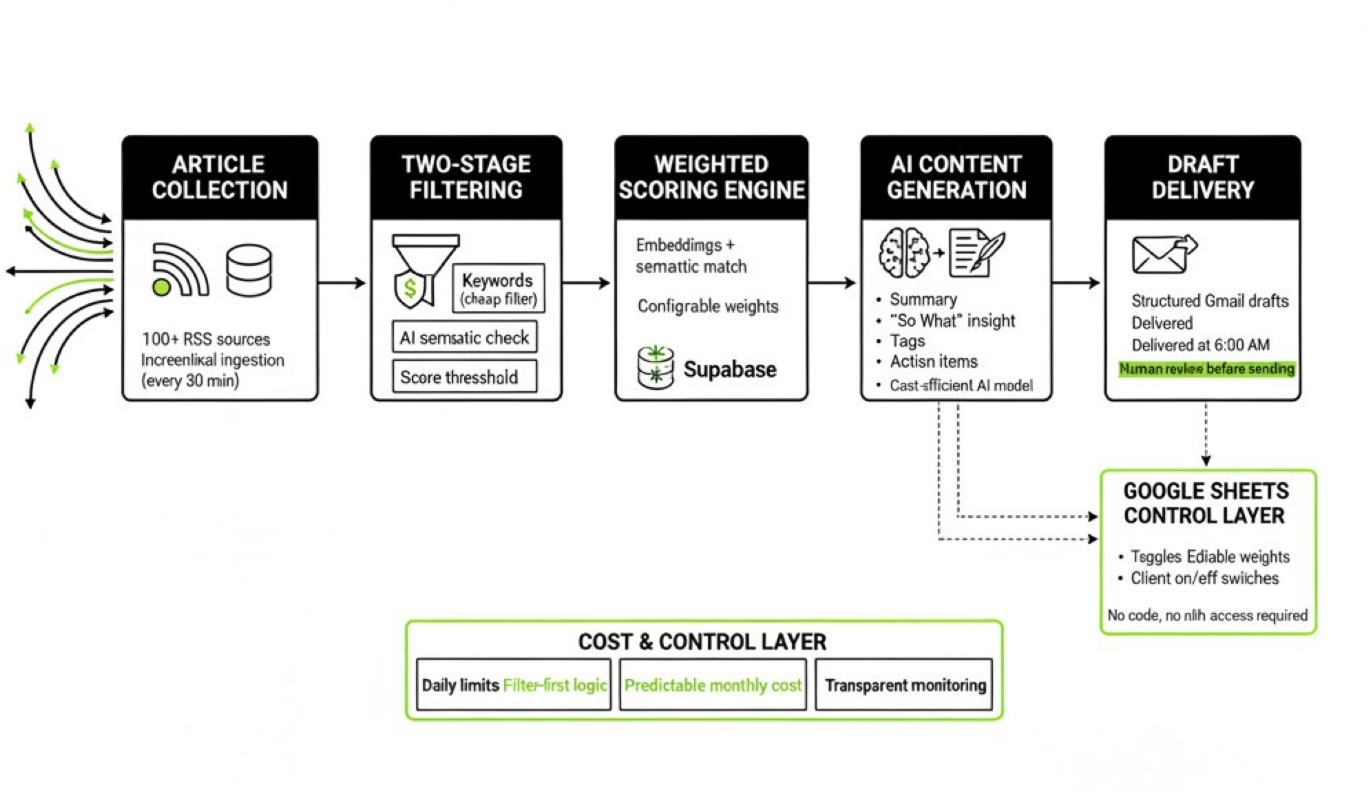
Five modules on n8n, built as production infrastructure rather than a clever workflow. Each one exists to remove a specific part of Brian's morning.
- Collection
Over 100 RSS feeds pulled through the Inoreader API every 30 minutes, incrementally rather than in one daily flood, so performance stays flat as feeds are added. - Two-stage filtering
Keyword screening against client-specific terms first, then GPT semantic analysis only on what survives. Filtering before applying intelligence is what keeps the AI bill small. - Vectorized scoring
A weighted model built from Brian's own methodology. Keywords, competitors, activity triggers and risk topics carry different weights, vector embeddings catch semantic matches that exact terms miss, and everything lands in Supabase with a relevance score from 0 to 3. - Personalized generation
For anything above the threshold, GPT-4o-mini writes a one or two sentence summary, the client-specific "so what", tags, and up to three suggested actions. - Draft assembly
A structured Gmail draft with an executive summary, the relevant items, and a watchlist of entities to monitor.
The drafts are drafts, deliberately. The workflow runs at 3am and the brief is waiting in Brian's inbox at 6am, unsent. He reviews and sends. Client communication going out under his name without him reading it was never the goal.
Everything he needs to change lives in a spreadsheet
Brian asked to adjust the scoring weights himself, so we moved every configuration into Google Sheets:
- A client tab holding profiles: keywords, competitors, industries and triggers
- A variables tab holding scoring weights, daily article limits and timing
- A single enable and disable column for switching a client on or off
Daily operations require no code and no n8n access.
Building it
Week one was discovery. Rather than walking a non-technical founder through architecture, we worked from outcomes and business logic. When Brian shared his scoring methodology document, our job was translating his thinking into a system.
The first API we chose did not work out. Feedly's developer token turned out to require an Enterprise account. We moved to Inoreader, which offered better API access at lower cost. Finding that in week two rather than at launch is the difference between a detour and a problem.
Weeks two and three were iterative: a beta to validate the core flow, then refinement on the email format and scoring logic against Brian's real feeds, then dynamic weight configuration once he asked for more control.
Handoff documentation covers adding and modifying clients, adjusting weights, what to check if a draft does not arrive, and how to trigger a workflow manually. It is written for a non-technical reader.
The numbers
Reported by Contrail Financial after the system went live.
The morning, before and after
Before
Hours a day reading hundreds of articles, deciding what each client needed to see, writing the summaries and assembling ten separate emails.
After
Ten to fifteen minutes reviewing briefs that are already drafted and waiting, then sending them.
What that unlocked
- Scale without proportional time.
Collection, filtering, analysis and drafting no longer grow with the client count. The system is architected for 50 to 100 clients, and cost scales linearly: roughly $180 to $200 a month at fifty. - Consistency that reads as reliability.
Every client gets their brief every morning regardless of how busy Brian is that week, which is the whole point of positioning yourself as a dependable strategic partner. - The briefs became a sales tool.
With existing clients handled automatically, Brian could extend briefs to prospects and demonstrate the value before asking for a commitment. That was not possible when each one cost him an hour.
Under the hood
- Stack
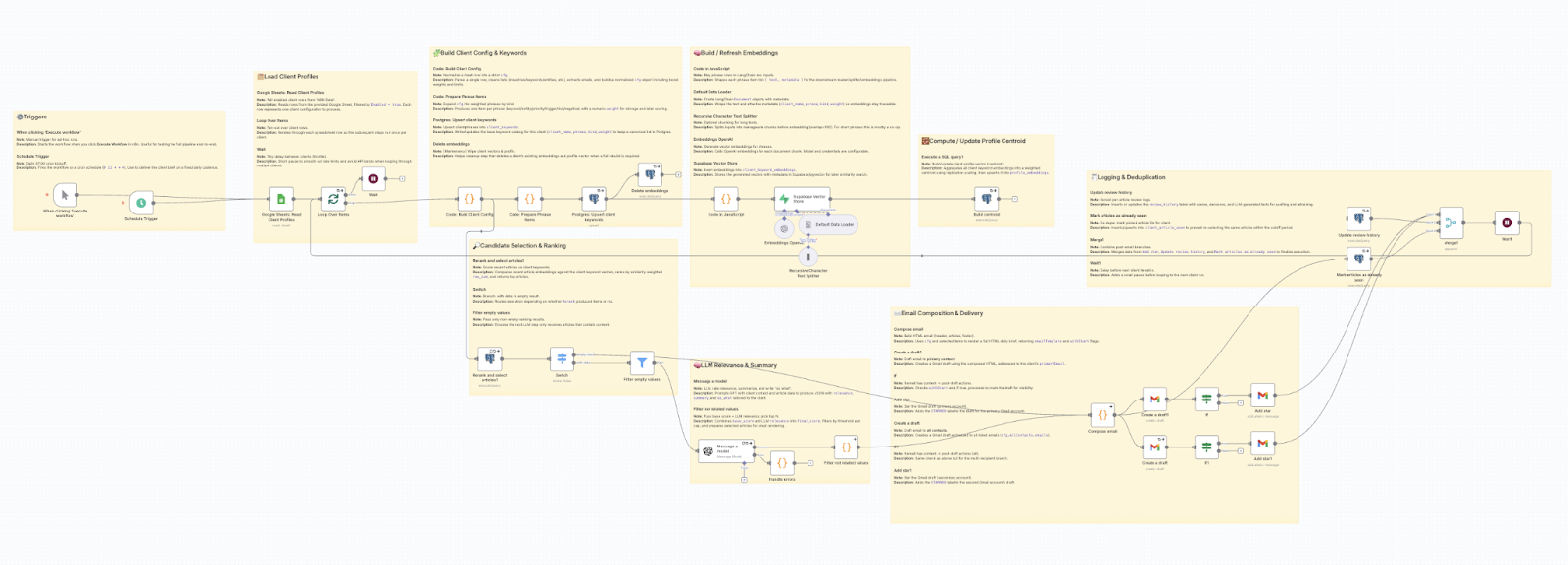
n8n Cloud for orchestration, Inoreader for RSS, OpenAI GPT-4o-mini for analysis, Supabase on PostgreSQL for storage, Google Sheets as the client interface, the Gmail API for drafts, and Scrapfly for full article text. - Architecture
Incremental collection every 30 minutes, vector embeddings for semantic matching, SQL-based scoring for speed, a 3am scheduled run, and separate collection and processing workflows so one cannot bottleneck the other. - Built for 10x from day one
Database schema, API rate limiting and workflow structure all accommodate 100+ clients without a redesign.
Why this one is worth reading
Brian's firm runs lean. He cannot hire a development team and he is not going to learn to code. His realistic options were doing it by hand forever, which does not scale, or hiring an assistant, which is expensive and still manual.
What he got instead costs less per month than one of his billable hours and returns thirty of them. That is the whole case for automation at this size, and it does not require the business to become technical to hold it.
I had a great experience working with 2V Automation. They were highly responsive, knowledgeable, and professional throughout the project. The team delivered the full scope quickly and efficiently, meeting my expectations in both quality and communication. I'd confidently recommend 2V Automation to anyone looking for a capable and dependable automation partner.
 Brian FaustCEO @ Contrail Financial
 More client stories
 Facility Services - Fire Safety Compliance
 How Fire Plan Strategies Eliminated 230 Manual Hours a Month
~230 hrs / monthManual ops time eliminated
Lead intake, quotes, invoicing and certificates, automated
Read the story"This is music to my ears. Our accountant is definitely going to love this because she's not going to have to do invoices anymore. The admin staff is also..."
 Championship Ring Manufacturing
 Signature Champions: From Spreadsheet Chaos to Automated Revenue
300+ hrs / monthManual ops time eliminated
Custom software development and automation
Read the story"300+ hours of manual work eliminated every month. Recurring processes that ate our team's time are gone entirely."