
Business process automation services, one process at a time
For businesses past $1M in revenue that run on people moving data between tools. We spend a week inside your operations, rank what is worth automating, then build it in your own accounts.
Business process automation (BPA) is the use of software to run a repeatable, multi-step business process across your tools, from the event that starts it to the finished result, so people only handle the decisions and the exceptions.
Business process automation services are the outside team that decides which of your processes are worth automating, builds them, and hands them over running. At 2V we start with a one-week discovery, then automate one process at a time in the order that pays back first.
- Who it is for
- Owners and operators of businesses past $1M in revenue, usually 5 to 50 people
- Where it starts
- Automation Discovery Week: $2,000 for 1 to 20 people, $4,000 for 21 to 50
- What gets built
- n8n workflows, custom internal software, AI agents, or settings in software you already pay for
- Project price
- $6,000 to $24,000 each, three to six weeks, priced before it starts
- Who owns it
- You. It runs in your accounts and keeps working without us
Where the manual work hides
The same data, typed twice
An order arrives by email, then someone keys it into the ERP, the invoicing tool and a spreadsheet.
Approvals live in inboxes
Work waits for a reply nobody knows is pending, and status means asking around.
One person holds the process
It runs because they know the steps. When they are away, it stops.
Growth means another hire
Every new client adds coordination work, so revenue and headcount climb together.
What business process automation is, and what it is not
Every automated process has the same four parts. Miss one and you have a demo.
- A trigger. Something starts it: a form submitted, a contract signed, an invoice due, a row added, a time of day.
- Your systems of record. It reads from and writes to where the data actually lives: CRM, ERP, accounting, project tool, inbox, shared drive.
- Rules. The branches and checks that decide what happens to each case, including which cases go to a person.
- Monitoring. Logs, retries and an alert to a named person when something fails, so nothing breaks silently.
It helps to know what BPA is not, because each of these is budgeted and staffed differently:
| Term | What it does | How it relates to BPA |
|---|---|---|
| A single zap or macro | Copies one thing from one app to another | A single task. BPA runs the whole sequence, with its exceptions. |
| RPA (robotic process automation) | A bot clicks through a screen like a person | One technique inside BPA, for systems with no API. Fragile when the screen changes. |
| An AI agent | Reads, classifies or drafts where rules run out | A step inside an automated process, with a person approving what matters. |
| Digital transformation | A company-wide change program | BPA is one of the things you do in it, one process at a time. |
Workflow automation is the same idea at a smaller scale: one piece of work moved through its steps. Business process automation strings those workflows together across teams. If you want the platform view first, read what n8n is and how it compares in n8n vs Make vs Zapier.
Which processes are worth automating first
Most businesses have twenty candidates and budget for two or three. This is the checklist we use to rank them.
Three questions before you score anything
- Should this step exist at all? A report nobody reads should be deleted before anyone automates it.
- Does software you already pay for do it? Your CRM, accounting or help desk tool often has the rule built in and switched off. Configuring it costs far less than any build.
- Is it done one way? If three people run the same process three ways, agree on one first. Automating a broken process only makes it fail faster.
Then score each candidate from 1 to 3 on four things
| Criterion | 1 point | 2 points | 3 points |
|---|---|---|---|
| Volume | Monthly or less | Weekly | Daily or many times a day |
| Rules | Judgment on every case | Mostly rules, some exceptions a person can take | Rules you can write down |
| Systems touched | One system (configure it there instead) | Two systems | Three or more, with data retyped between them |
| Error cost | Mistakes are rare and easy to fix | Mistakes cost hours of rework | Mistakes reach customers or money: a wrong invoice, a missed renewal |
How to read the total (4 to 12): 10 to 12 is a first-wave candidate. 7 to 9 waits for wave two. 6 or below stays manual, gets simplified, or goes to an AI agent with a person approving the output.
A worked example (illustrative)
Take a made-up 25-person distributor with three candidates. Hours are runs times minutes per run, over a month of 21 working days.
| Process | Volume | Rules | Systems | Error cost | Score | Time today |
|---|---|---|---|---|---|---|
| Purchase orders from email into the ERP and invoicing | 3 | 2 | 3 | 3 | 11 | 40 a day x 6 min = 84 hrs a month |
| Weekly sales report for the owner | 2 | 3 | 2 | 1 | 8 | 4 a month x 3 hrs = 12 hrs a month |
| Contract redlines | 1 | 1 | 1 | 3 | 6 | Low volume, needs a lawyer's judgment |
Order entry goes first: it scores highest and holds most of the hours. The PO formats vary, so an AI step reads them and a person checks anything it is unsure of. The report is a second-wave job, unless the reporting tool can already schedule it. The redlines stay with a person.
The score ranks candidates; it does not price them. In a discovery week we cost every candidate in hours and dollars and sequence them by payback. To run the numbers yourself, use our automation ROI template.
What business process automation looks like in each team
The same pattern shows up everywhere: an event, a few systems, rules, and a person only where judgment is needed.
Sales automation
Lead intake and routing, CRM updates, quotes and pricing agreements generated from the deal, handoff to delivery when it closes.
Sales automation →FinanceFinance automation
Invoices raised when a milestone completes, tax rules applied by region, payments matched, month-end reports assembled.
Finance automation →OperationsOperations automation
Order and dispatch flows, document generation, certificates triggered by payment, status updates without phone tag.
Operations automation →SupportCustomer support automation
Tickets classified and routed, answers drafted from your own content, escalations raised before the SLA is missed.
Support automation →PeopleHR and recruiting automation
Candidate intake and screening, onboarding checklists, accounts created and removed on time.
HR automation →Not sure where yours fits?Automation by team
Every team and the builds we do for each, on one page.
All solutions →The right tool depends on the process
We pick after we have looked. Most clients end up with a mix.
Software you already pay for
When your CRM, accounting or help desk tool can do the job with the right settings, we configure it and stop there. No build needed.
n8n
Workflows between the tools you already run, with error handling, retries and alerts. Self-hosted or n8n Cloud, your choice. We are a certified n8n Expert Partner.
n8n automation agency →When nothing fitsCustom software
Portals, internal tools and systems of record built on Laravel when no product fits how your business works.
Custom software →Where rules run outAI agents
Agents that read documents, classify tickets or draft replies, with guardrails and a person approving what matters.
AI agent development →Moving off Zapier or Make? We rebuild rather than import, and run old and new side by side before cutover. See Zapier to n8n migration. Want to host it yourself? n8n can run on your own servers (n8n hosting docs), and we set it up in self-hosted n8n.
How a business process automation engagement runs
What we build in phase three depends entirely on what we find in phase one.
- Phase 1
Discovery week
We spend a week inside your operations, with the people doing the work, and find where the time and the margin go.
One week - Phase 2
The plan
A map of how your business runs today and a ranked list of what to change first, with the payback on each item. Yours to keep.
End of week one - Phase 3
Build
One process at a time, in the order the plan ranked them. Depending on the process, that means configuring software you already have, an automation layer on n8n, custom software, or an AI agent. Each one is scoped to pay back on its own.
Three to six weeks per project - Phase 4
Improve
The systems run on their own. If you want us to stay, we keep improving them and take on the next process.
Optional
What the discovery week produces
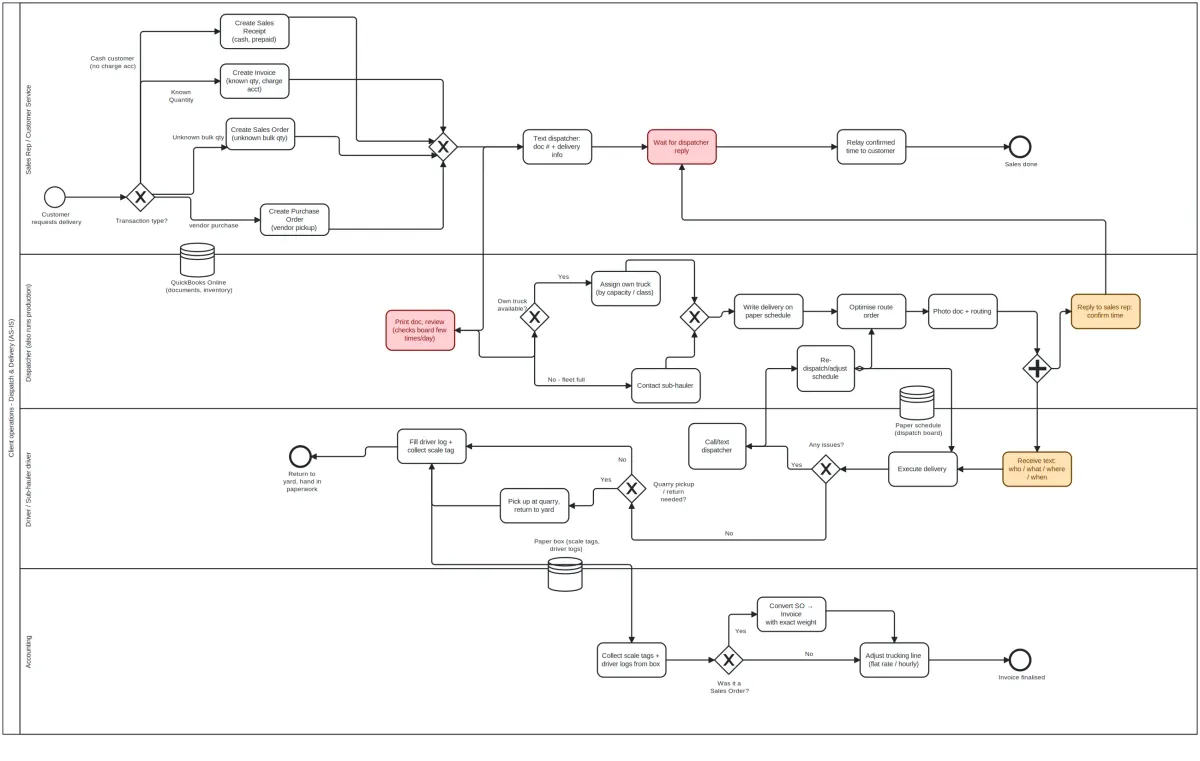
We sit with the people doing the work, about six hours of your team's time, and trace real jobs end to end. Then we model the process in BPMN, the standard notation for business processes, cost every automation candidate, and write the proposal. You keep the model, the roadmap and the proposal whatever you decide next.
What happens inside each project
- Scope and price. The project is priced before it starts, against the roadmap. The number you approve is the number you pay.
- Build in your accounts. On your tools and credentials, small sub-workflows rather than one giant canvas, with error handling and alerts.
- Run in parallel. The new process runs next to the old one on real data until the team trusts the output.
- Cut over and hand over. The old way stops, your team is trained, and the documentation is written in plain language.
Most clients do two or three projects in the first few months. You can stop after any of them.
Business process automation we have shipped
 Facility services, fire safety compliance ~230 hrs of manual operations eliminated every month
Lead intake, quotes, invoicing and certificates, automated on self-hosted n8n for a Canada-wide fire safety services company. Every lead used to be typed into three systems by hand.
Fire Plan Strategies → Financial consulting, fractional CFO 30+ hrs of founder time returned every month
Five n8n modules that read over 100 RSS feeds, score each article per client, and leave a personalized brief in the founder's Gmail drafts by 6am. He reviews and sends.
Contrail Financial → Championship ring manufacturing ~300 hrs of manual operations eliminated every month
A custom portal for coaches, customers, sales reps, plants and admins, with communication and order processing automated around it. Built for a ring maker that was running a $5M business on spreadsheets.
Signature Champions → International conferences, under NDA Events and conferences 2 hrs to produce a 78-page program, down from 1 week, checks includedProgram-at-a-glance timetables and full session programs, generated from Airtable as editable Google Slides or print-ready PDFs. One form, eleven document versions.
International conferences, under NDA → Warranties and protection plans 15 min between each sync of orders and customer details to HubSpot
A multi-storefront Magento platform that issues warranty contracts from the order itself, syncs every order to HubSpot every 15 minutes, and automates card holds, refunds and contract retries.
OnPoint Warranty →“We are saving 230 hours every single month. Work that used to take a full team now runs on autopilot.”
 Mariano
FirePlan Strategies · Read the case
“300+ hours of manual work eliminated every month. Recurring processes that ate our team's time are gone entirely.”
 Kyle Winchell
Signature Champions · Read the case
What business process automation costs with us
Discovery week
$2,000 for 1 to 20 people, $4,000 for 21 to 50, a short call first above 50.
Paid when you book. Full refund any time before the gathering starts, except card and currency fees.
Each project
$6,000 to $24,000, three to six weeks, priced per project before it starts.
Not billed by the hour or the week. Each one stands on its own.
Maintenance
Optional. Nothing to buy up front.
If you want us to keep improving it or take on the next process, we quote that once a build is live.
What decides where a project lands in the range
- How many systems it touches. Each connection needs mapping, testing and error handling.
- How much is built rather than configured. Turning on a setting is cheap; a custom portal is not.
- How fast you want it. Sooner means more people on it, which costs more.
What it costs to run
Tool subscriptions are yours and billed by the vendor: n8n Cloud or your own server, and AI model usage where an agent is involved. Check current plans on n8n's pricing page. For scale, the daily briefs we built for Contrail Financial cost $55 to $60 a month to operate at 10 clients.
If you already have a specification, a design or a roadmap from someone else, we skip the week and price the build in milestones. See pricing for both tracks.
BPA consultant, software vendor, or in-house hire?
| Automation consultant (us) | Software vendor | In-house hire | |
|---|---|---|---|
| Who picks the process | We do, with you, from a week inside the operation | You do; the vendor shows what its platform can do | Your hire, once they learn the business |
| Who builds it | Analyst, engineers and tech lead, on the tool that fits each process | You, or the vendor's partner, on that vendor's platform | One person, on the tools they know |
| Cost shape | Fixed price per project, approved before it starts | Licences per seat or per run, plus implementation | Salary and benefits, every month |
| If it stops | Runs in your accounts, documented; anyone can pick it up | Workflows live on the vendor's platform | Knowledge leaves when the person does |
| Fits best when | You know something is wrong but not what to fix first | The process is clear and the platform already covers it | Automation is a permanent, full-time workload |
Questions to ask any business process automation company
- Will you look at our operations before you quote a build?
- Where will it run, and what happens to it if we stop working together?
- Who is alerted when a workflow fails, and how fast?
- Is the price fixed per project, or billed by the hour?
- Can we see a case with numbers the client stands behind?
- Will you tell us when something is not worth automating?
For a wider list of firms, see our roundup of the best AI automation consultants. If you want the strategy question answered before any tool question, that is AI automation consulting.
Why automation projects fail, and how we avoid it
Automating a broken process
Three ways of doing one job become three brittle workflows. We agree the one way with the people who do the work, in BPMN, before building.
Nobody owns it
Workflows nobody owns rot when an API or a rule changes. Each one gets a named owner on your side who receives its alerts.
The team does not trust it
If the people using the output were not involved, they keep the old spreadsheet. We run old and new in parallel, train the users, then cut over.
It breaks silently
A failure nobody sees costs more than the manual work did. Every build has logs, retries and an alert to a person.
Only the builder understands it
Key-person risk moves from your staff to your vendor. We document every workflow and the data it touches in plain language.
AI acting on its own
Anything touching money, customers or compliance gets a person approving it. Most clients start an agent on read-only access.
More on keeping workflows healthy after launch: n8n best practices
Questions people ask first
What do business process automation services include?
Four things: finding which processes are worth automating, designing how the automated version works, building it in your tools, and handing it over with documentation and monitoring. With us that starts with the Automation Discovery Week, then one project at a time, $6,000 to $24,000 each.
What does a workflow automation consultant do?
They map how work actually moves through your business, find where people retype data or wait on each other, decide which steps software should take over, and then build it. A consultant who only advises leaves you with a plan; one who also builds leaves you with something running. We do both.
What is the difference between BPA and RPA?
BPA connects your systems through their APIs and runs the whole process. RPA (robotic process automation) is a bot that clicks through a screen like a person would, which you need only when a system has no API. RPA is one technique inside BPA, and it breaks more easily when the screen changes, so we use it as a last resort.
How much do business process automation services cost?
With 2V, the discovery week is $2,000 for 1 to 20 people and $4,000 for 21 to 50. Each build is $6,000 to $24,000, priced per project before it starts. Tool subscriptions (n8n, AI model usage) are billed to you directly by the vendor. Full details are on the pricing page.
How long does it take to automate a process?
The discovery week takes one week for 1 to 20 people and up to two weeks for 21 to 50. Each project then takes three to six weeks, and you see working pieces along the way. The slow parts are rarely the technology: access to systems and decisions from your side set the pace.
Which workflows can be automated?
Any process that starts from a clear event, follows rules you can write down, and keeps its data in systems with an API: order entry, invoicing, lead routing, onboarding, reporting, document generation. Steps that need judgment can often be drafted by an AI agent and approved by a person.
Do we need our own tech team?
No. The analyst, engineers and tech lead are ours. Your side needs one person who knows how the business runs and can make decisions.
What happens if we stop working with you?
Everything keeps running. It is built in your accounts, on your tools, documented in plain language, and your team is trained on it. There is no 2V platform in the middle, so another developer can pick it up.
Find out which of your processes are worth automating.
One week inside your operations, $2,000 for a team of 1 to 20. You keep the map and the costed plan whether you build with us, with someone else, or not at all.